
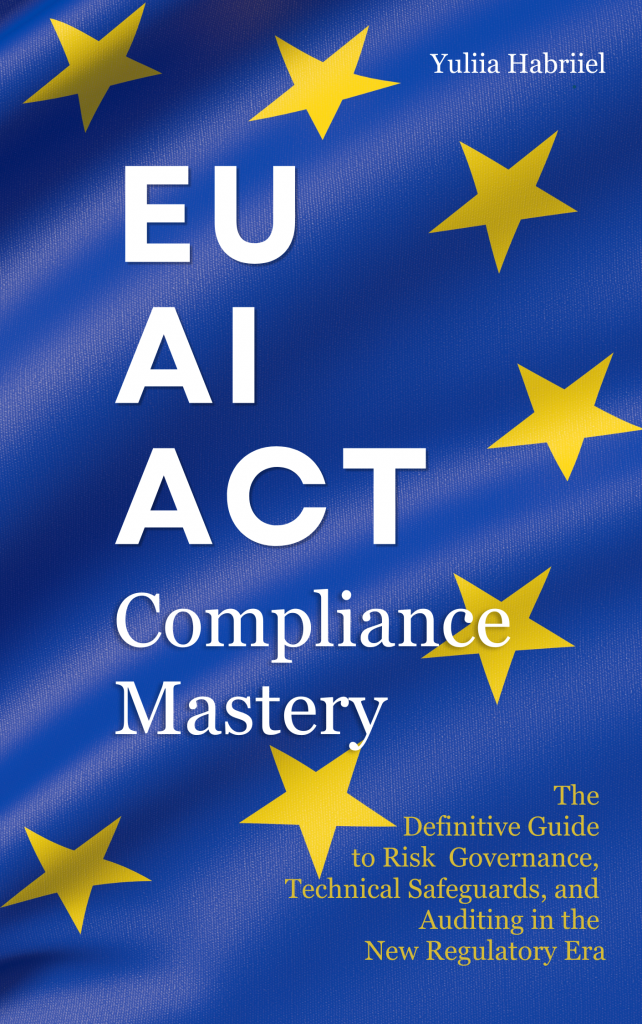
EU AI Act Compliance Mastery
The Definitive Guide to Risk Governance, Technical Safeguards, and Auditing in the New Regulatory Era
Part of AI Literacy Compliance Kit
Why EU AI Act Compliance Matters
In the evolving digital landscape, launching or managing an AI system without a compliance strategy is like driving a supercar blindfolded. The EU AI Act isn’t just a localized set of rules—it is the new global benchmark for artificial intelligence regulation. Organizations worldwide that deploy or sell AI within the European market must align with these strict legal mandates or face staggering penalties of up to €35 million or 7% of global annual turnover.
Beyond avoiding historic fines, AI compliance is quickly becoming a massive competitive differentiator. Companies that bake transparency, accountability, and robust governance into their models early will win the trust of enterprise clients, investors, and consumers alike. AI compliance isn’t a roadblock; it’s the foundation of sustainable innovation.
What the EU AI Act Compliance Mastery Book Covers
This comprehensive guide breaks down complex regulatory jargon into actionable, developer- and executive-friendly strategies. The book covers:
- Risk categorisation: Mastering the breakdown between Unacceptable, High, Limited, and Minimal risk systems.
- Data governance and bias mitigation: Implementing strict data quality controls to prevent algorithmic bias and meet EU standards.
- Technical documentation: Generating audit-ready architecture maps, logging protocols, and conformity assessments.
- Human oversight integration: Designing user interfaces and operational workflows that keep humans meaningfully in the loop.
- Post-market monitoring: Setting up continuous feedback loops to detect and report systemic risks after deployment.
These modules bridge the gap between abstract legal text and practical engineering, ensuring your technical architecture naturally supports your compliance goals.
How AI Compliance Ties into Business Success
- Market expansion: Unlock frictionless access to the lucrative European single market by proving compliance from day one.
- Investor and Enterprise Confidence: De-risk your technology stack to attract institutional funding and secure enterprise-level B2B contracts.
- Future-proof Innovation: Build a flexible compliance framework that adapts seamlessly as global AI regulations evolve.
- Brand Reputation: Position your organisation as an ethical AI leader, turning regulatory alignment into a core marketing asset.
It is important to dispel the myth that “governance stifles innovation.” This is not true. In my years of experience delivering industry solutions in Responsible AI, good governance practices have contributed to more innovative products. I use the phrase ‘brakes help you drive faster’ to explain this phenomenon – the ability to stop a car in dangerous situations enables us to feel comfortable driving at fast speeds. Governance is innovation.” — Dr. Rummam Chowdhury
The Book: Your Blueprint for Technical and Legal Alignment
EU AI Act Compliance Mastery cuts through the noise to provide a highly practical implementation manual for engineering teams, compliance officers, and C-suite executives:
- Step-by-step blueprints for high-risk AI system compliance.
- Ready-to-use checklists for pre-deployment conformity assessments.
- Real-world case studies of successful AI governance frameworks.
- Developer-friendly checkpoints for logging, transparency, and data validation.
We make complex regulatory requirements practical, transparent, and manageable—so your engineering team can stay agile without compromising on legal security.
Take the Next Step
The regulatory clock is ticking, and enforcement timelines are already closing in. Preparing your systems now means smoother audits, lower engineering friction, and a massive head start over your competitors.
Be the first to master the new rules of the game. Register today to lock in exclusive Early Bird Pricing and receive bonus compliance templates upon launch.
FAQ
What is the current compliance deadline for high-risk AI systems under the EU AI Act?
Following the recent passage of the 2026 AI Act Digital Omnibus amendments, the compliance deadlines for high-risk AI systems (HRAIS) have been officially extended to give businesses more preparation time:
- December 2, 2027 – Deadline for standalone “Annex III” high-risk AI systems (e.g., AI used in employment, biometrics, education, and critical infrastructure).
- August 2, 2028 – Deadline for “Annex I” product-regulated AI systems (e.g., AI integrated into medical devices, aviation, or machinery safety components).
In EU AI Act Compliance Mastery, we break down these staggered timelines into an agile roadmap so your engineering team meets every milestone without panic.
Which AI systems must comply with the August 2026 transparency obligations?
While high-risk deadlines were extended, Article 50 transparency obligations go into effect on August 2, 2026. This applies to:
AI-Generated Synthetic Content: Systems must output machine-readable, detectable watermarks.
Chatbots & Conversational AI: Must clearly disclose to users that they are interacting with an AI system.
Emotion Recognition / Biometric Systems: Users must be explicitly notified when these systems are active.
Are US and international companies subject to the EU AI Act regulations?
Yes, because EU AI Act has extraterritorial reach, meaning it applies to any organization worldwide if the AI system’s outputs are used or made available within the European Union. Whether you are a Silicon Valley SaaS startup or an enterprise provider based in Asia, if an EU citizen interacts with your model or its data, you must comply or face cross-border enforcement penalties.
What are the maximum financial penalties for violating the EU AI Act?
The EU AI Act enforces some of the steepest regulatory fines in digital history, categorized by severity:
- Prohibited AI Practices: Fines up to €35 million or 7% of global annual turnover (whichever is higher) for deploying banned systems like non-consensual deepfakes or social scoring.
- High-Risk Non-Compliance: Fines up to €15 million or 3% of global annual turnover for failing to meet governance, logging, or data quality standards.
- Incorrect Information: Fines up to €7.5 million or 1.5% of global annual turnover for supplying misleading documentation to regulatory bodies.
How does the EU AI Act distinguish between “prohibited” and “high-risk” AI?
The framework utilizes a strict risk-based classification system:
High-Risk: Systems used in critical sectors like healthcare, hiring, law enforcement, and credit scoring. These are legal but require rigorous data governance, human oversight, and mandatory registration in the EU database.
Prohibited Risk: Systems that pose an unacceptable threat to safety and fundamental rights (e.g., untargeted biometric scraping, subliminal manipulation). These have been illegal since early 2025, with new prohibitions on non-consensual intimate content taking effect in late 2026.
What technical documentation is required to pass an EU AI Act conformity assessment?
To achieve audit-ready compliance for a high-risk AI system, developers must maintain a live, comprehensive technical file containing:
- Detailed system architecture descriptions and algorithmic design specifications.
- Data governance logs mapping data collection, provenance, and bias-testing methodologies.
- Automated continuous logging protocols (traceability metrics) to track system performance and decision-making over time.
- Detailed instructions for use (IFU) outlining necessary human oversight workflows.
How can software teams prepare for EU AI Act audits without slowing down development?
The most effective way to balance compliance with innovation is to implement Compliance-by-Design. Instead of treating audits as a post-development hurdle, engineering teams should automate transparency logging, integrate bias testing into automated CI/CD pipelines, and map user access permissions directly onto role-based hierarchies early.
EU AI Act Compliance Mastery serves as your practical implementation manual, showing your founding and legal teams exactly how to co-author compliance guardrails that accelerate—rather than stall—your product launch.