EU AI Act Template Pack
The AI Act documents your investors and auditors expect.
Every EU AI Act obligation needs a governance file. AI policy, system inventory, risk assessment, oversight records, incident procedure, vendor due diligence — structured exactly the way a regulator, a notified body, or an investor’s lawyer expects to see it.
A law firm drafts this for €5,000+. Your own team spends two to three weeks getting the structure right. This pack is that work — already done.
Built by the lawyer who authored all 180+ AI Act obligations into a compliance engine. She knows what each document has to prove.
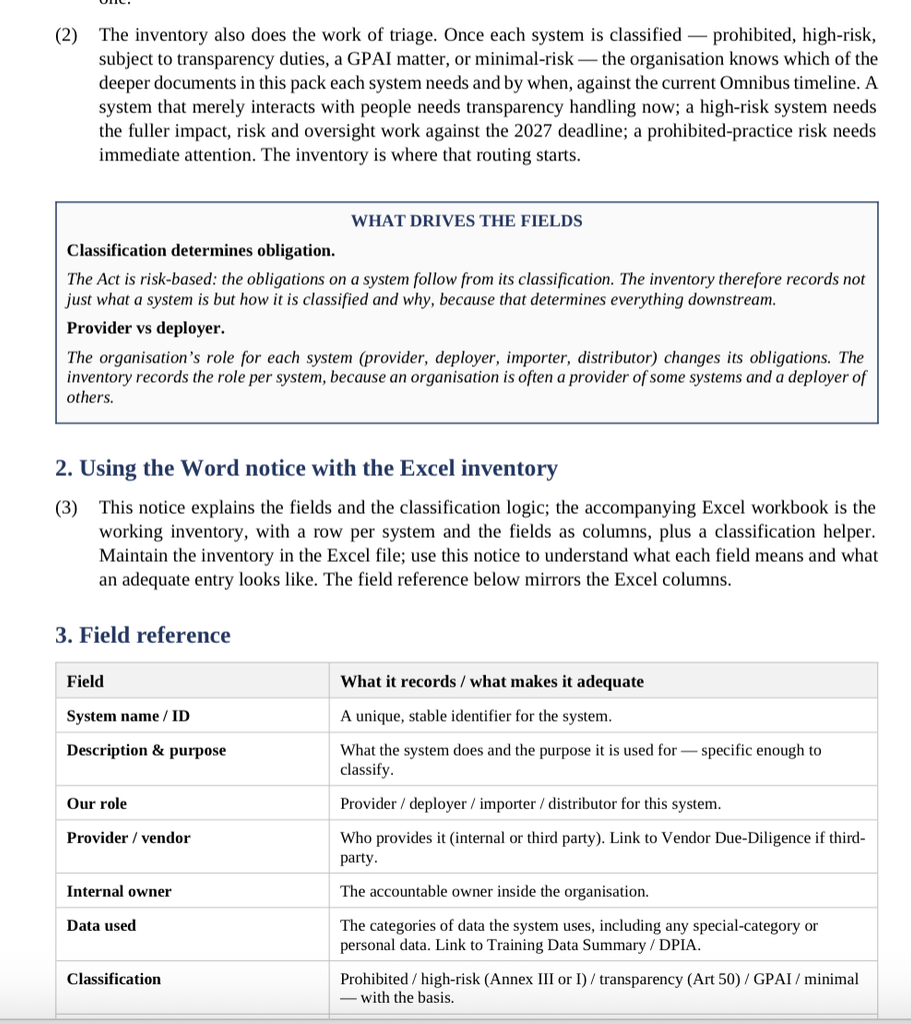
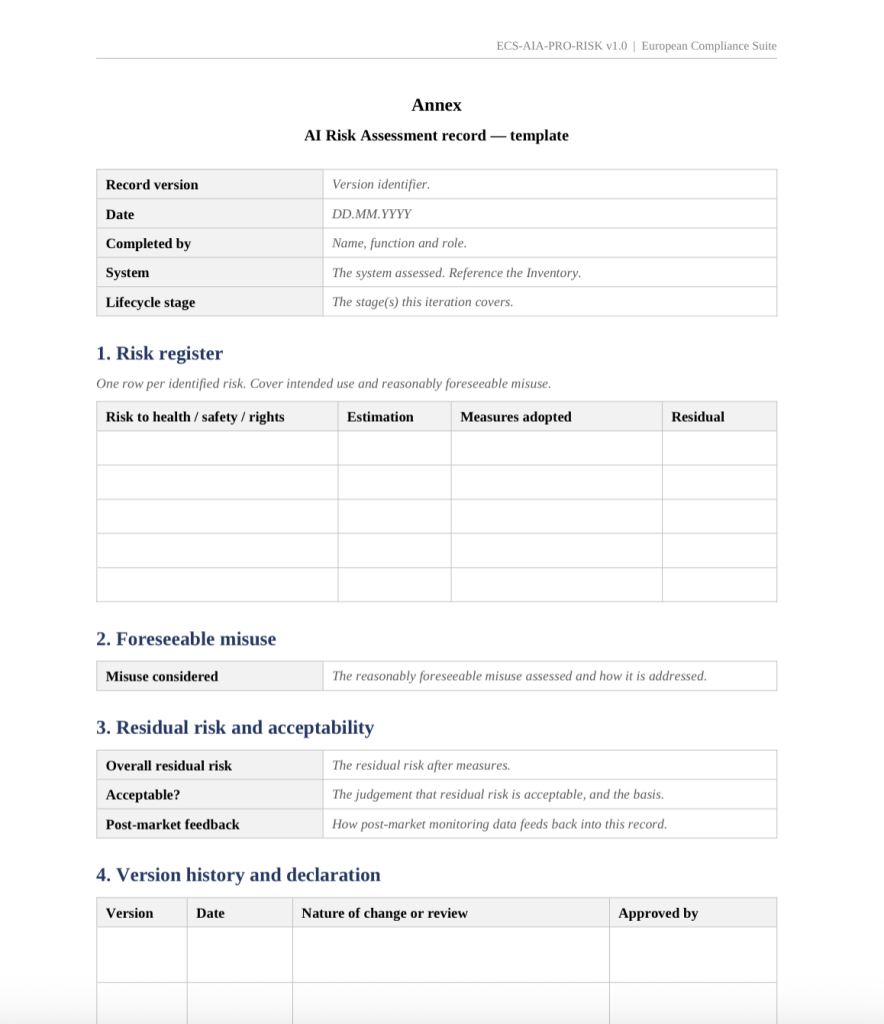
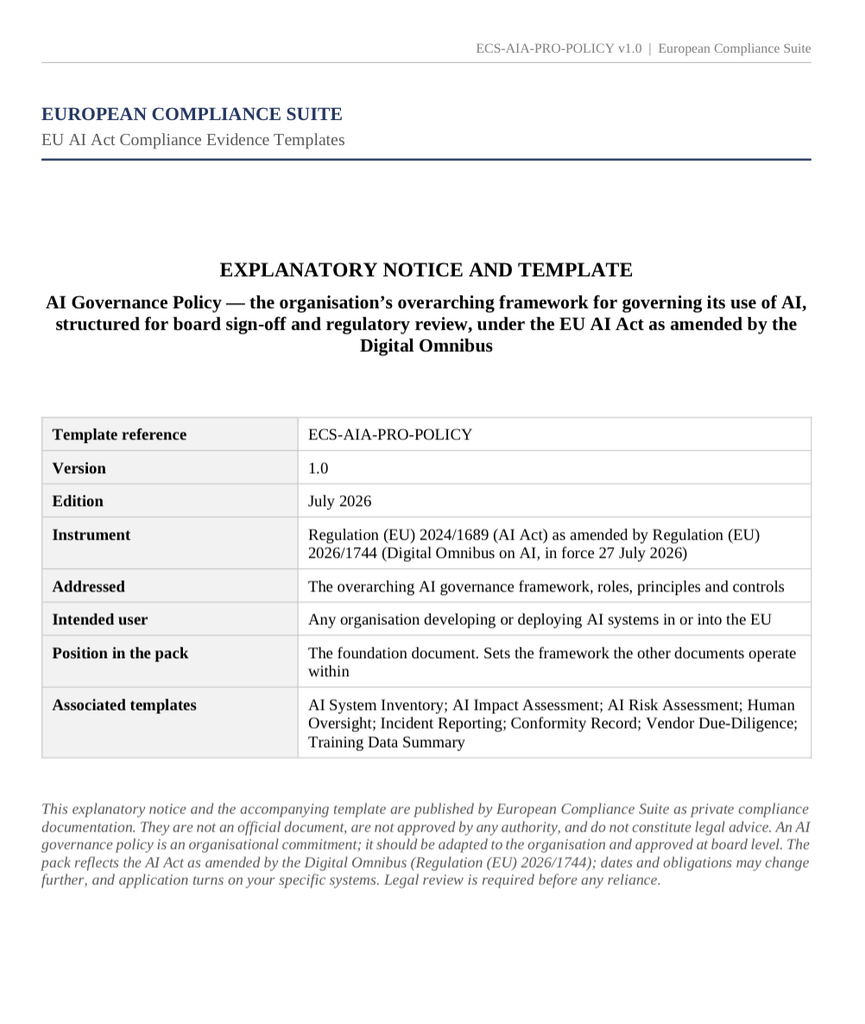
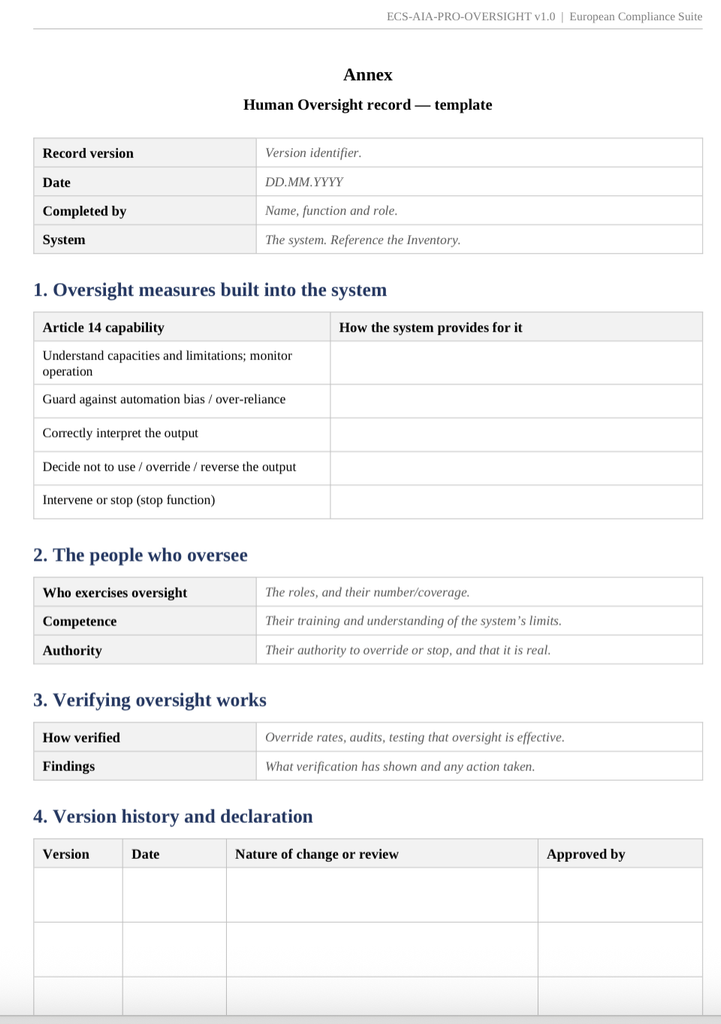
What’s included in this EU AI Act template pack:
Structured to the AI Act’s own document architecture
This EU AI Act templates were built by the lawyer building a compliance engine that models the entire regulation, obligation by obligation. If it doesn’t save you the two weeks it promises, refund within 30 days, no questions.

9 core documents
AI Governance Policy
System Inventory (Word + Excel)
Impact Assessment
Risk Assessment
Human Oversight Procedures
Serious Incident Reporting Procedure
Conformity Assessment Record
Vendor Due-Diligence Template
Training Data Summary
The Completion Guide
The part that actually saves the two weeks. Field by field: what goes in it, why the field exists, and what makes an answer hold up under review. This is the difference between a template and a document you can defend.
Post-Omnibus Readiness Checklist
One page telling you exactly which obligations are live now, which the Omnibus deferred, and which document here covers each. So you know where you stand, not just what you own.
Lifetime updates
The Act is still moving. As delegated acts and guidance land, the templates update and you get them free. The Omnibus changes are already incorporated.
“But didn’t the Omnibus give me until 2027?”
For one category, yes. For the obligations that can actually bite you this year, no — and that’s the trap.
What actually changed, and what didn’t
This is the accurate post-Omnibus map, current to Regulation (EU) 2026/1744.
| Obligation | Position after the Omnibus | When it bites |
|---|---|---|
| Article 5 prohibited practices (original list) | Unchanged since Feb 2025 | Now |
| Article 5 — new NCII / CSAM ban | Added by the Omnibus | 2 Dec 2026 |
| GPAI model obligations | Unchanged since Aug 2025 | Now |
| Article 50 — AI interaction & content disclosure | Unchanged | Aug 2026 |
| Article 50(2) watermarking — new systems | Unchanged | Aug 2026 |
| Article 50(2) watermarking — already-deployed systems | Legacy grace | 2 Dec 2026 |
| Annex III standalone high-risk | Deferred | 2 Dec 2027 |
| Annex I embedded high-risk (incl. machinery) | Deferred, still in scope | 2 Aug 2028 |
The documents in this template pack address the top four rows, not the bottom two. They cover the governance foundation that applies whatever your risk tier and whatever the Omnibus deferred: how you govern AI, how you assess and record risk, how you evidence oversight, how you report an incident.
Where EU AI Act templates help — and where they do not
Most compliance template packs sell you a form and let you believe that filling it in makes you compliant. On some obligations that is true. On others it is dangerous, and pretending otherwise is how organisations end up with a folder full of documents that would not survive first contact with an auditor.
This EU AI Act template pack tells you the difference, on every template.
Where the document is the obligation. Your AI governance policy, your system inventory, your incident-reporting procedure, your vendor due-diligence record — for these, a well-structured, correctly completed document is exactly what the Act asks for. The kit gives you those, built to the right structure, ready to complete.
Where the document only records the obligation. Your risk controls, your human oversight, your data quality — the Act here regulates what your system actually does, not what your paperwork says. A “human oversight procedure” does not create oversight; it records oversight that must already exist in the product.
The template pack gives you these templates, too, but framed honestly, as evidence records of real work, with the completion guide telling you plainly what the engineering behind each one has to look like before the document means anything.
No other pack draws this line. It is drawn here because the person who built these templates also built a compliance engine on exactly this principle: a document is not a system. Buying documentation that pretends otherwise is worse than buying nothing, because it manufactures false confidence on the obligations where you are most exposed.

Built by someone who worked on the Act
I’m Yuliia Habriiel, regulatory lawyer and AI governance practitioner (IAPP AIGP). I engaged in the AI Act’s drafting, I wrote a chapter-by-chapter field manual on the Act, and I’m building a compliance engine that authors this regulation into machine-runnable form, obligation by obligation.
That last part is why these templates are different. Building the engine meant authoring every obligation in the Act down to the level of “does a document satisfy this, or does it take engineering” — for all 180-plus of them. That distinction is baked into every template here.
This is documentation, not legal advice. Where you need the determination — is my system high-risk, what is my role, does a prohibition apply — that is the EU Product Compliance Assessment, not a template. This pack gives you the right structure to document a position and the assessment actually determines one.
Who needs this template pack:
- Founders and product teams who need a governance file before an investor meeting, a procurement questionnaire, or a launch — and need it to hold up.
- Compliance and legal teams who know what must be documented and want a correct structure, not a blank page.
- SaaS, MSP, and platform companies meeting AI Act obligations for the first time.
- DPOs and AI governance leads who want Article 9, 10, 14, and 73 structure without commissioning a firm.
- Anyone shipping a chatbot or a generative feature into the EU, where Article 50 is live now and the deferral does not help you.
- Anyone who read “deadline extended,” exhaled, and hasn’t yet checked what stayed in force.
What our customers say:

Thank you for sending the strategy doc. I did not even expect it to be customised so it provides a good strategy tool to help me think about developing my application.

Meredith Godat, PhD
Founder, CogniQuest (Switzerland)
We’ve been trying to figure out how the EU AI Act affects our drone platform, especially around AI-based navigation. The report helped make sense of what actually applies to us and what we need to pay attention to. It gave us a much better picture of where we stand and what we need to do next before expanding into the EU market.

Denis Isakovs,
CTO, ProDrone
(Latvia)
Before this document collection, every AI Act discussion ended in confusion. Now I can confidently present classification decisions to our legal team and explain timelines to stakeholders. Worth every euro.

Robert Müller
Head of Product, MediciTech Solutions (Germany)
30 days. Full refund. No haggle.
Review the template pack. If it doesn’t save you the weeks of drafting it promises and give you a file you’d be comfortable putting in front of an auditor or an investor, email within 30 days for a full refund. The guarantee exists because the work should speak for itself.

Audit-Proof Documentation

Lifetime Legal Updates

No Legal Help Required

Immediate Delivery
Get Your EU AI Act Templates Today
✔ Editable Word & Excel
✔ Post-Omnibus Readiness Checklist
✔ Lifetime updates as delegated acts and guidance land
✔ Corporate invoice available
✔ 30-day full refund
One-time payment. No subscription.
Frequently Asked Questions
Does the Omnibus extension mean I don’t need this yet?
No — and this is the mistake the page is built to correct. The Omnibus (Regulation (EU) 2026/1744) moved the standalone high-risk deadline to 2 December 2027. It did not touch prohibited practices (in force since Feb 2025), GPAI obligations (since Aug 2025), or Article 50 transparency (from Aug 2026) — and it added a new Article 5 prohibition on NCII/CSAM generation with a 2 December 2026 deadline. This kit addresses the obligations that are live now, not the ones that moved.
What is Article 50 and does it apply to me?
Article 50 requires providers and deployers of AI that interacts with people to disclose it’s an AI, and to label synthetic content, emotion recognition, and biometric categorisation. It applies from August 2026 and the Omnibus did not defer it. If you run a chatbot, a virtual assistant, an automated support system, or anything generating content that could pass as human-made, Article 50 applies to you now. Watermarking for systems already deployed follows on 2 December 2026 — and note, that watermarking is an engineering task, not a document. These EU AI Act templates help you govern and record it, it does not implement it.
Some of these are called “evidence records” — why?
Because for some obligations the Act regulates what your system does, not what your paperwork says. Risk controls, human oversight, and data quality are properties of your product; a template records them, it doesn’t create them. We label those three templates honestly and the completion guide in EU AI Act templates tells you what the underlying engineering has to look like before the record means anything.
Every other pack blurs this. We don’t, because filling in an oversight template without real oversight is worse than having no template — it’s documented false confidence on exactly the obligations where you’re most exposed.
Template pack or assessment — what’s the difference?
Our EU AI Act templates give you the structure to document a position. The assessment gives you the position — which frameworks apply, your risk tier, your role, what prohibitions touch you. If you already know your position, the kit documents it.
If you need it determined, start with the EU Product Compliance Assessment (€1,250 for one system, while the Cross-Regime Assessment covers up to three across every applicable framework at €4,950).
Does EU AI Act template pack guarantee compliance?
No. EU AI Act templates give you documentation in the structure a regulator, notified body, or investor expects, and a guide explaining what each field requires. Whether your answers are legally correct for your circumstances is a judgement the templates can’t make for you — and on the evidence-record templates, whether you’re compliant depends on engineering the document only records.
Can I use these across multiple clients?
The licence covers your own organisation and systems. Consultancies and compliance teams using our EU AI Act templates across client engagements need a multi-use licence — contact us before purchasing.
How long to complete?
A compliance-literate team member can work through our EU AI Act templates for a single system in an afternoon; larger inventories take longer. The research and structure are done — what’s left is your system’s specifics.
Are EU AI Act templates updated as the Act develops?
Yes. Lifetime updates: as delegated acts, harmonised standards, and Commission guidance land, the templates are revised and you get the updates at no extra cost. The Omnibus revisions are already reflected.
Can I just ask ChatGPT to produce templates for me?
You can ask ChatGPT to generate AI governance policies, risk assessments, registers, and compliance documents. However, AI can create individual documents, but it won’t necessarily provide an up-to-date EU AI Act documentation framework because large language models may not reflect the latest regulatory guidance and cannot verify whether every required document is included. Missing a key register, procedure, assessment, or governance control can create compliance gaps you can discover only when it’s too late.
Besides, AI-generated templates are often broad, inconsistent, and not structured for practical implementation. Teams frequently spend hours refining documents before they are usable.
Our EU AI Act templates provide a professionally structured, interconnected set of documents designed to work together from day one. Instead of spending weeks prompting, reviewing, editing, and validating AI-generated content, you get a ready-made, lawyer-developed compliance framework that can be customised to your organisation in hours.