
EU AI ACT COMPLIANCE TEMPLATES
50 (1) AI Agent and Chatbot Disclosure Pack
Article 50 applies from 2 August 2026.
Four documents that record how your AI system tells people they’re dealing with a machine, and the reasoning where you rely on the exception that lets you stay silent. Drafted by a qualified lawyer, includes twelve months of updates.
EU AI Act Art. 50 (1): Does This Apply to You?
Here are three simple questions. If you answer yes to all three, Article 50(1) applies to you.
1. Do you provide an AI system that interacts directly with people?
A chatbot, voice assistant, or conversational agent through text, voice, or an on-screen avatar. If it talks to a person, it counts.
2. Is it available to people in the EU?
Where you’re established makes no difference. What matters is whether people in the EU interact with it.
3. Do you put it on the market under your own name or brand?
Article 50(1) binds the provider, at the design stage — not the business that merely deploys someone else’s bot. If you built it or badge it as yours, the duty is yours.
The catch isn’t the duty. Telling someone they’re talking to an AI is one sentence. The catch is the exception — you don’t have to disclose where it’s already “obvious” to a reasonable person that they’re dealing with a machine. That word is doing enormous work, and if you rely on it and get it wrong, the exposure is yours.
What Article 50 Actually Requires
Article 50(1) requires you to design your system so a person is told they’re interacting with an AI — clearly, at the latest at the first interaction, and accessibly.
Unless it’s obvious. No disclosure is needed where interaction with an AI is obvious to a person who is “reasonably well-informed, observant and circumspect,” taking into account the circumstances and context of use.
That exception is where every real question lives. Is it obvious on a plainly automated support widget? Probably. Is it obvious on a phone line answered by a realistic synthesised voice, where the caller expected a person? Almost certainly not. The same system can be caught in one context and exempt in another — and the burden of showing the exception applies sits with you, not the regulator.
This pack is the structure for making that judgment defensibly, recording it, and evidencing that your disclosure is actually delivered the way Article 50(5) requires.
What You Get in this EU AI Act Template Pack
Applicability Assessment: Determines whether the obligation applies, and in which contexts of use. Assessed context by context, because a single system can need disclosure in one setting and qualify for the exception in another. Completed first.
The Record: The core document. How your system discloses, and — where you rely on the “obvious” exception — the reasoning, worked through four factors: what a reasonable person knows entering the interaction, what the interface signals, the medium, and what it costs the person to mistake the AI for a human. This is the analysis a regulator will want to see, structured so it holds up.
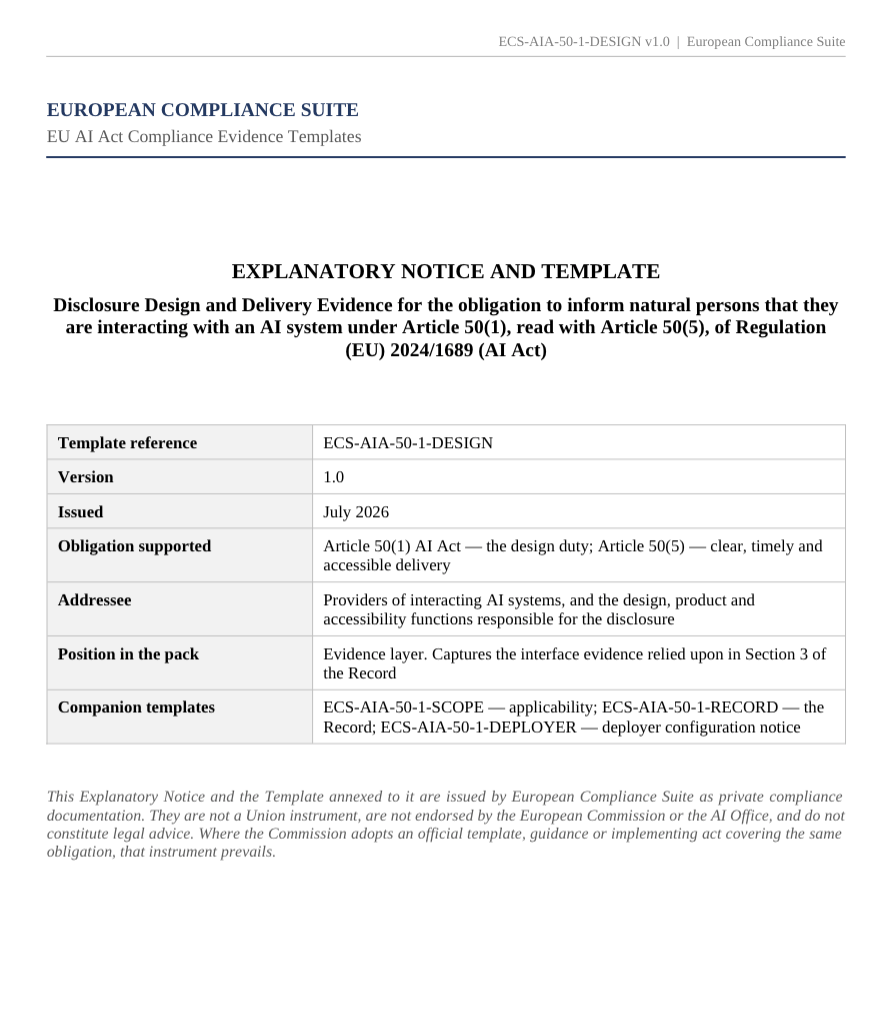
Disclosure Design and Delivery Evidence: The interface evidence behind the Record: the exact wording, where and when the disclosure appears, how it survives a long conversation, and how it reaches people using assistive technologies. Covers text, voice and avatar interfaces separately, because a disclosure built for a screen doesn’t serve a phone line.
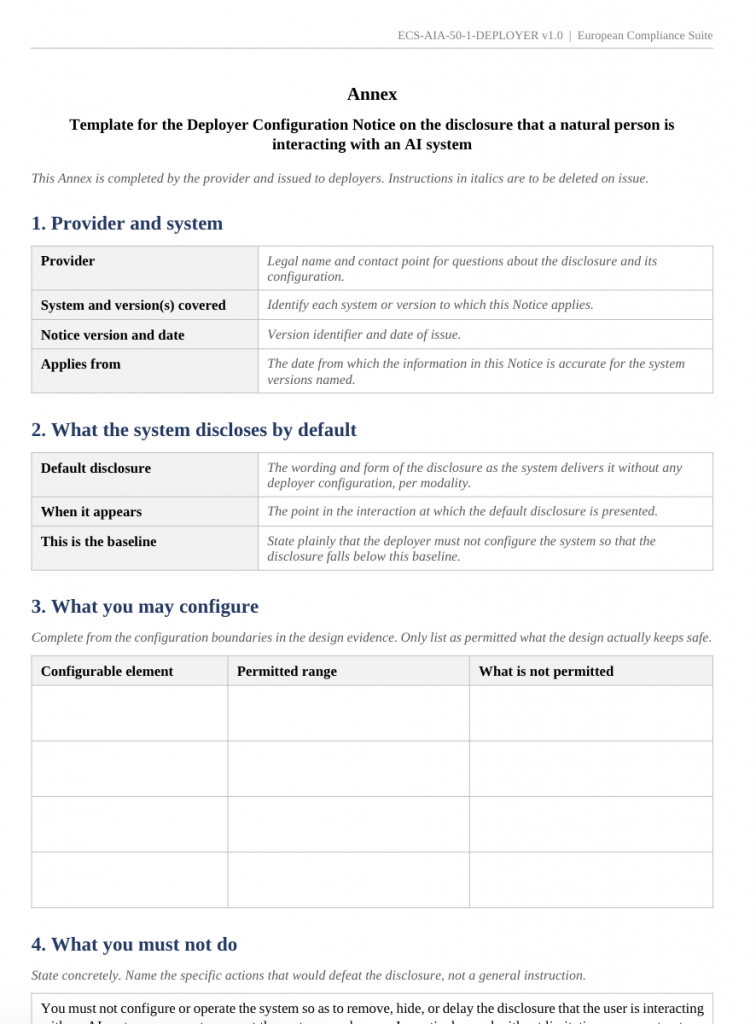
Deployer Configuration Notice: What you tell the businesses that deploy your system: what they may restyle, and what they must never do — like giving the assistant a human name and photo and passing it off as staff. Drafted so a deployer can’t quietly defeat a compliant design.
Every document follows the structure of the Commission’s own explanatory notices and templates. 34 pages. Word format, editable, plus a read-only PDF.
Start with the Free Document
The Applicability Assessment is free, complete, and requires no email address.
Work through it. If it tells you the obligation doesn’t apply — or that the “obvious” exception covers you — you have your answer and a document recording how you reached it. If it tells you you’re caught, you’ll know exactly which contexts of use need disclosure, and the rest of the pack follows.
Download Free Applicability Assessment
Who Created This Template Pack
Written by a qualified lawyer working in EU AI regulation, not assembled from a template library.
Commissioning the equivalent from a law firm is fifteen to thirty hours of specialist time. At prevailing rates that is €6,000 to €18,000.
What’s Included in the Price
€749 — the full pack, including twelve months of updates.
The Commission’s guidance on Article 50 is still settling, and the “obvious” exception is exactly the kind of question it will sharpen. When the position moves, you get the revised documents.
After twelve months, updates continue for €300 a year, or keep the version you have.
This Pack is Part of EU AI Act Article 50 Compliance Suite
Article 50 has more than one duty, and the same organisation often holds several.
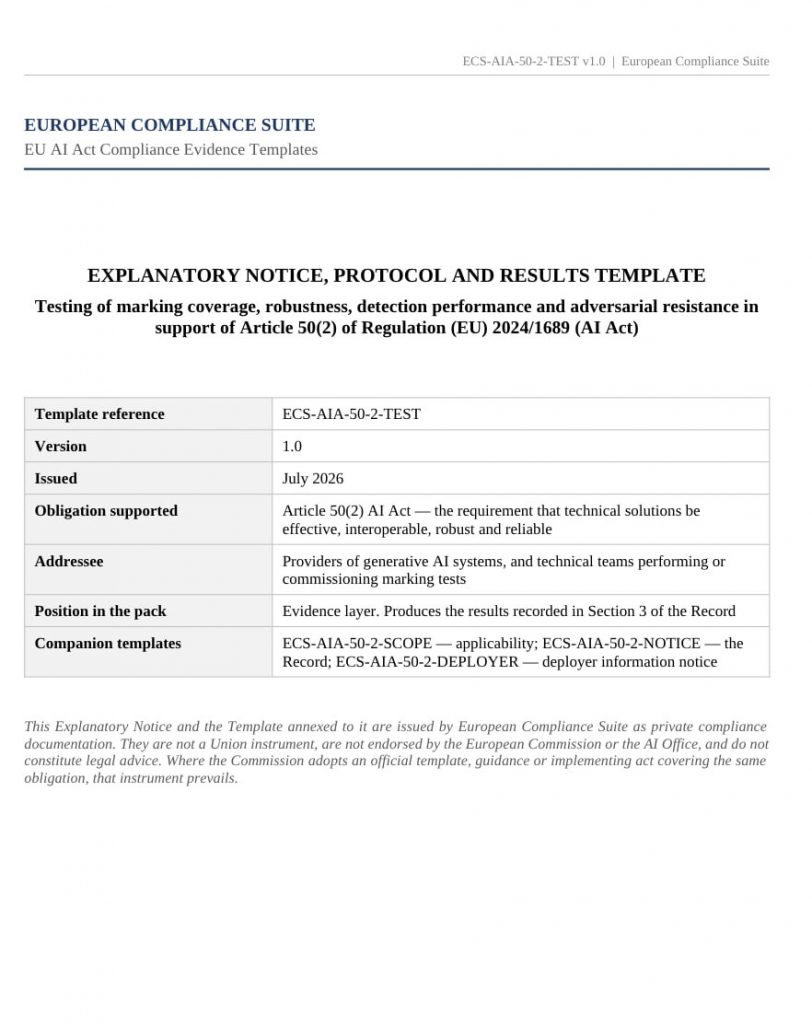
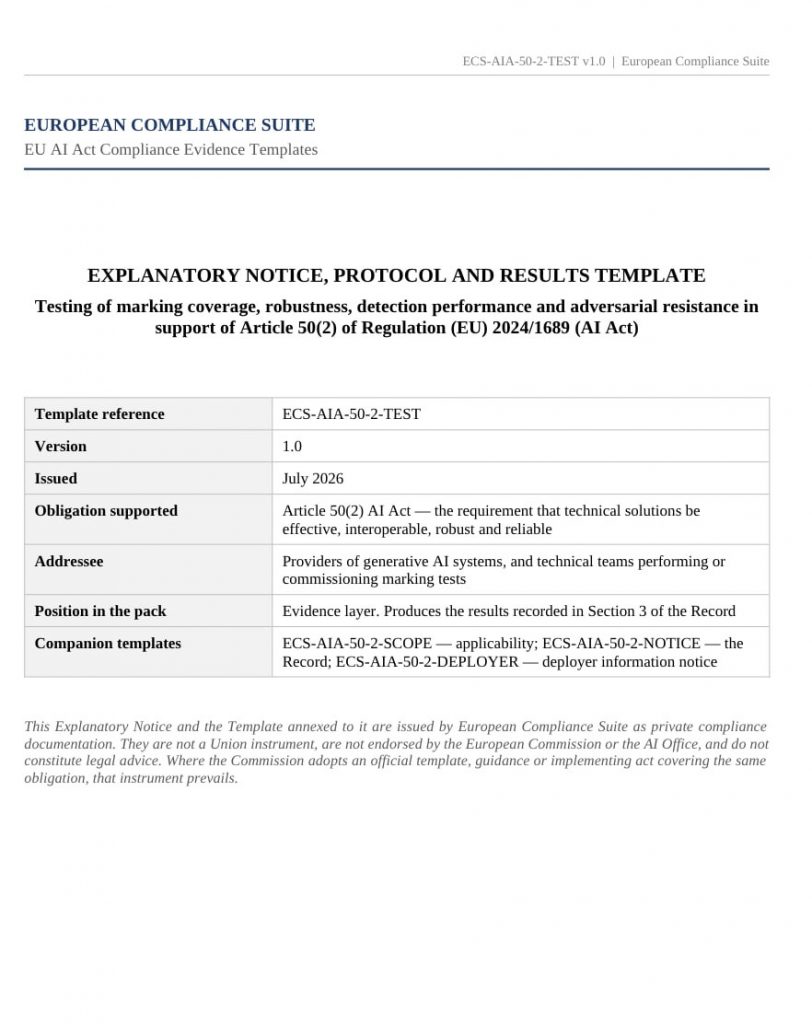
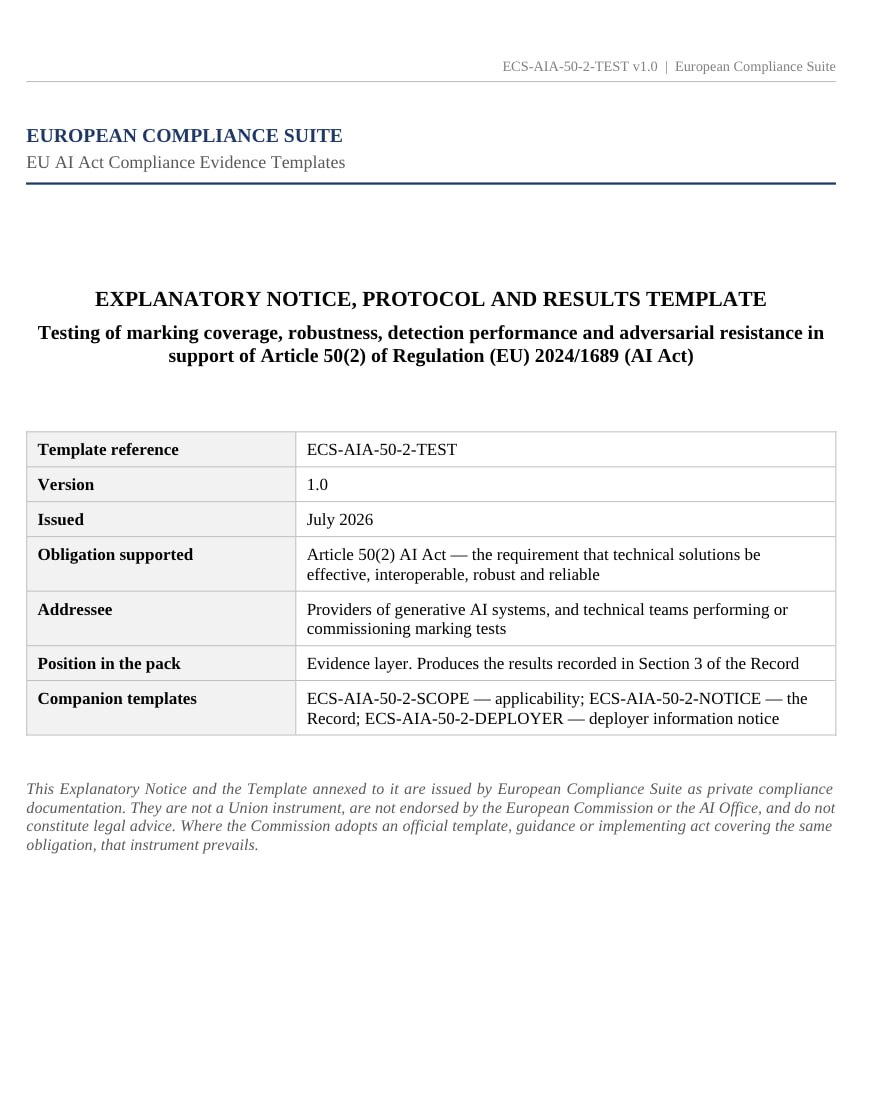
If your system also generates content — images, audio, video or text — you have a separate obligation under Article 50(2) to mark it as AI-generated. That’s a different pack.
Go to Synthetic Content Marking — Evidence Pack
If You Need More Than Compliance Documents
Pack with review: You complete the Record, we review it with particular attention to whether your reliance on the “obvious” exception would survive scrutiny. Then write up what’s weak and what’s missing.
Cross-regime product assessment: We do the product assessment across 12+ EU-specific frameworks and deliver the actionable report.
Authorised representative. For providers established outside the EU. On enquiry.
What This Pack Is Not
It is documentation, not advice on your particular circumstances.
The “obvious” exception turns on judgment about your specific contexts of use, and this pack structures that judgment — it does not make it for you. If your reliance on the exception is aggressive, a well-drafted record will show that plainly, which is the point of writing one before someone asks.
It does not make you compliant. It records what you designed and why, in the form an auditor, enterprise client, or investor is likely to expect. If the underlying disclosure is inadequate, the record will show it.