
Synthetic Content Marking Evidence Pack
Article 50(2), Regulation (EU) 2024/1689
Compliance evidence templates that record how your AI system marks generated content, and evidence that your synthetic content marking meets the standard the Regulation sets. Drafted by a qualified lawyer, includes twelve months of updates.
Article 50 applies from 2 August 2026. Systems already on the EU market before that date have until 2 December 2026.
4 documents, 53 pages
Does This Apply to You?
Here are four questions. If you answer yes to the first three, Article 50(2) applies to you.
1. Does your system generate or edit text, images, audio or video? Both count. A system that only edits is still caught where the edit is more than assistive.
2. Is it available to users in the EU? Hosted access, distributed weights, or a capability embedded in a product you supply into the EU. Where you are established makes no difference.
3. Do you put it on the market under your own name or brand? If so, you are the provider and the duty is yours. If you are using someone else’s system, Article 50(2) is theirs — but Article 50(4) may be yours.
4. Was it on the EU market before 2 August 2026? If yes, you have until 2 December 2026. If no, the duty applied from 2 August 2026.
Three things people get wrong: the obligation does not depend on your system being high-risk, open-source licensing does not exempt you, and text is in scope even though marking text is hard.
What the EU AI Act Article 50 (2) Actually Requires
Article 50(2) requires you to mark generated or manipulated outputs in a machine-readable format, and to make them detectable as artificially generated.
It also requires the marking to be effective, interoperable, robust and reliable, as far as is technically feasible.
That second sentence is where the work is. It is not a design claim — it is an empirical one, and answering it means knowing what proportion of your outputs actually carry the mark, whether the mark survives re-encoding and copy-paste, and how often detection is wrong in each direction. Most providers have not measured any of it.
This pack is the structure for recording what you did, what you measured, and why your solution meets the standard.
What You Get:
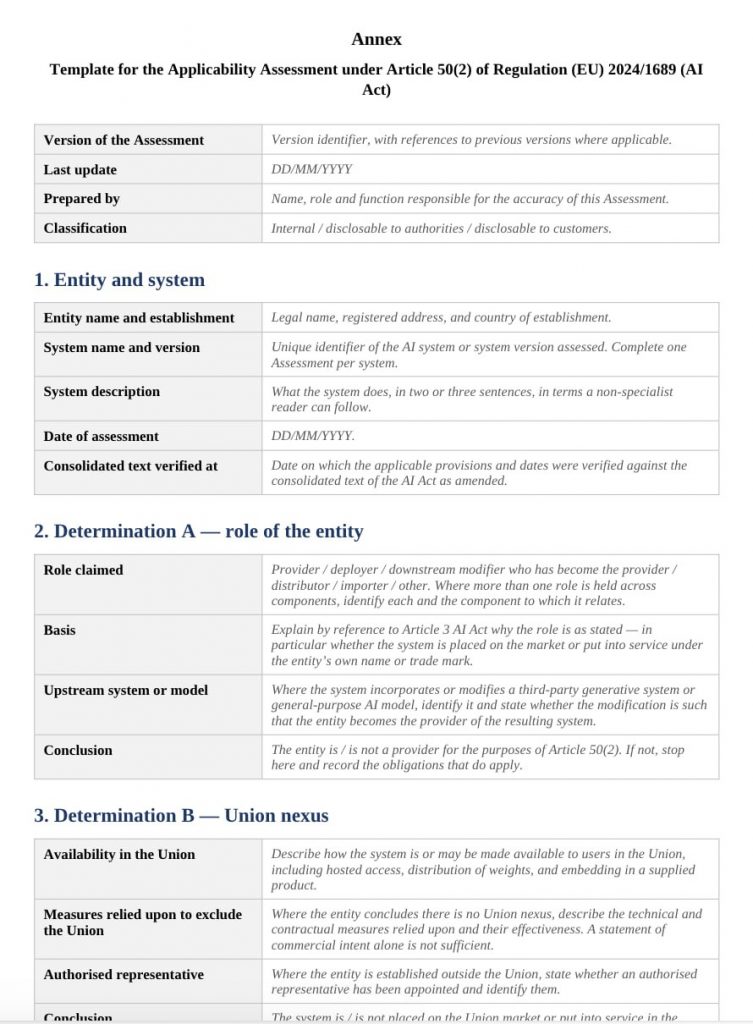
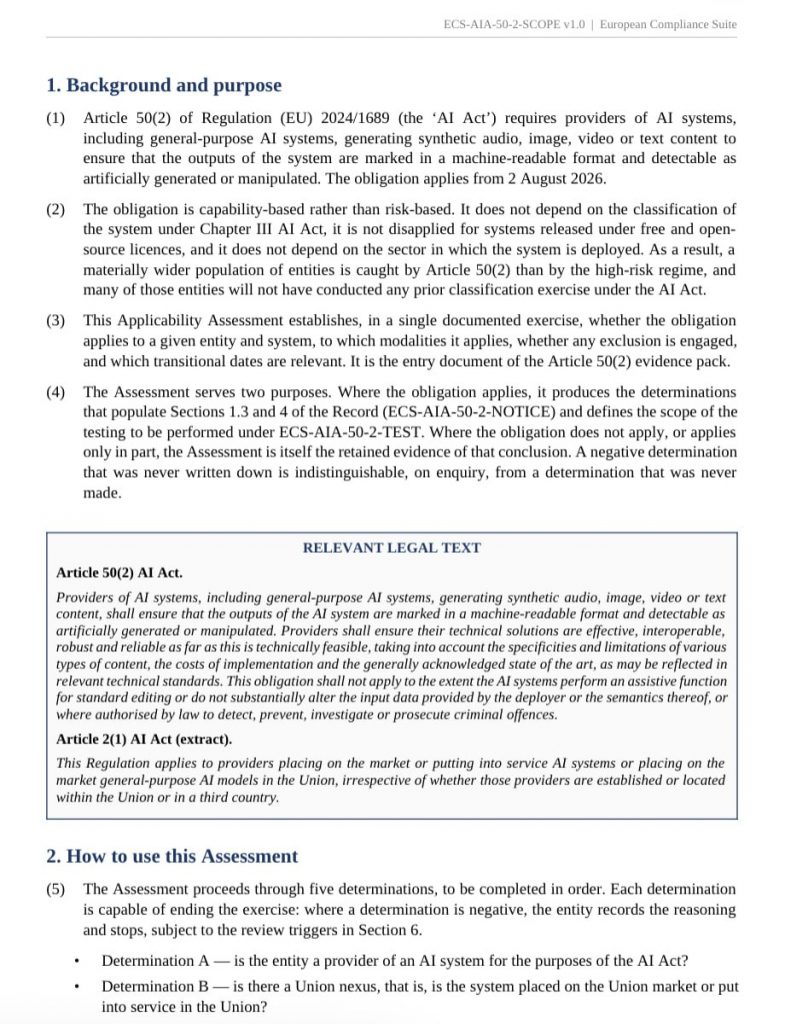
Applicability Assessment — 9 pages
Explanatory notice: background and purpose · How to use the assessment · the five determinations — role of the entity, Union nexus, generative capability by modality, exclusions, applicable dates · Outcome of the assessment · Relationship with other obligations · Review and re-assessment
Template: entity and system · Determination A, role · Determination B, Union nexus · Determination C, capability by modality · Determination D, exclusions — assistive editing, no substantial alteration, law-enforcement authorisation, residual scope · Determination E, applicable dates · outcome and consequential actions · review · version history and declaration
The Record — 16 pages
Explanatory notice: background · objective of the record · scope — systems, content, exclusions · the four qualifying criteria · balance with trade secrets and security of the marking solution · reporting conventions · relationship with the Code of Practice and the Commission Guidelines · modifications, updates and versioning · retention and availability · entry into application and transitional rules · enforcement · review
Template: general information — provider, system, generative capabilities and output modalities · marking and detection solutions — by modality, provenance metadata, watermarking, detection and interoperability, information provided to deployers, controlled-disclosure reference · assessment against the Article 50(2) criteria — effectiveness, interoperability, robustness, reliability, technical feasibility and proportionality, Code of Practice · exclusions claimed · monitoring, incidents and change control · interfaces with other obligations · version history and declaration
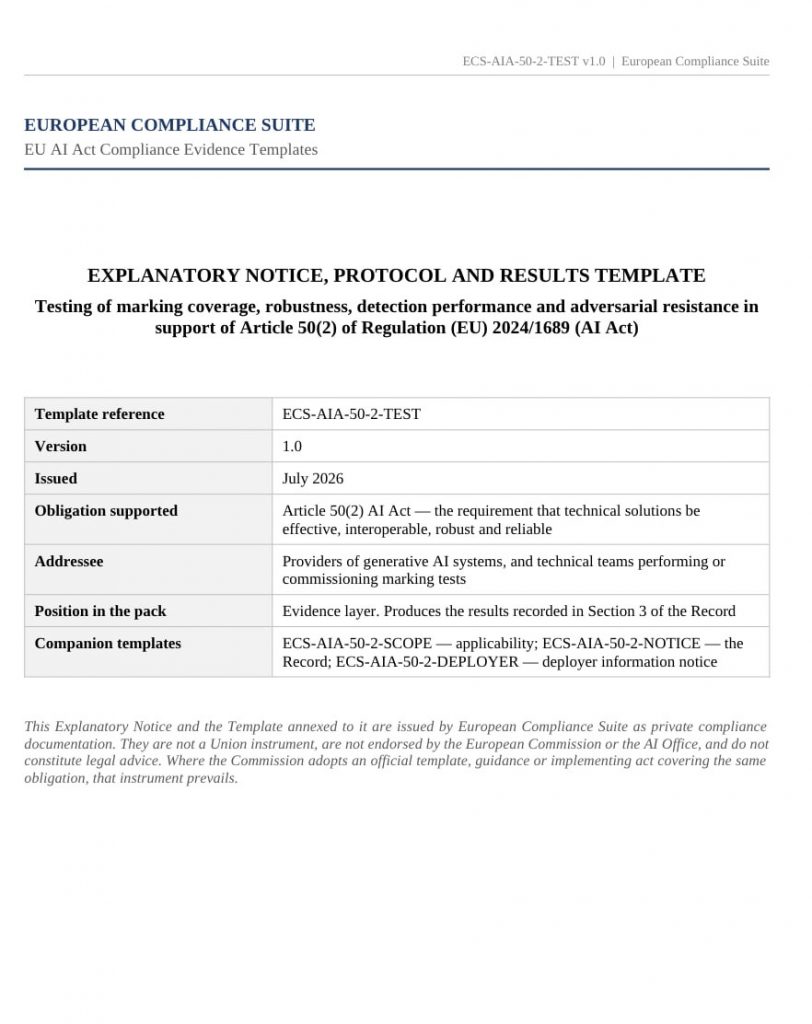
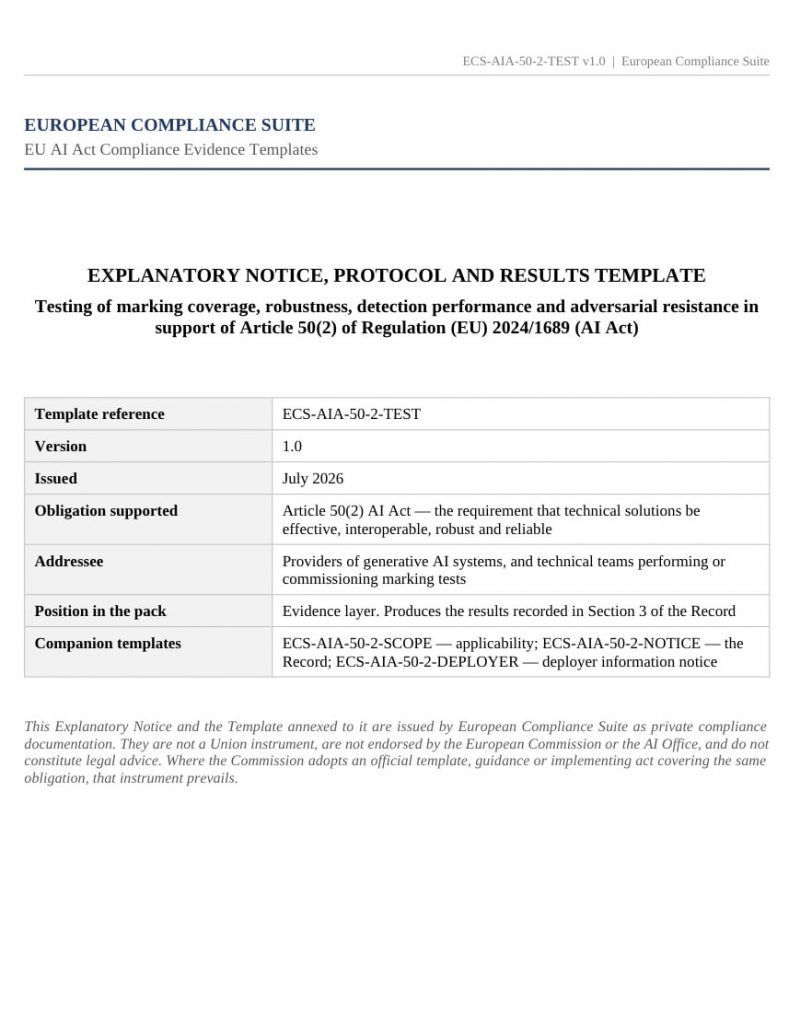
Marking Test Protocol and Results Template — 11 pages
Explanatory notice: background and purpose · what the testing must establish · design principles · test corpora · transformation sets for image, audio, video and text · adversarial testing · reporting conventions · cadence and retention
Template: campaign identification · test corpora · Test A, coverage of outputs · Test B, survivability under ordinary transformations · Test C, detection performance · Test D, adversarial resistance · Test E, cross-implementation readability · findings and mapping to the statutory criteria · version history and declaration
Deployer Information Notice — 7 pages
Explanatory notice: background and purpose · what the notice must contain · what the notice must not do · where the notice sits · maintenance
Template: provider and system · what is marked · how to detect the marking · what removes or degrades the marking · what this marking does not do · support and change notification · version history
43 pages. Word format, editable, plus a read-only PDF.
Start With the Free One
The Applicability Assessment is free, complete, and requires no email address.
Work through it. If it tells you the obligation does not apply, you have your answer and a document recording how you reached it. If it tells you it does, you will know exactly which modalities are in scope — and the rest of the pack is built to follow it.
Download the free Applicability Assessment
Who Wrote This
Drafted by a qualified lawyer working in EU AI regulation, not assembled from a template library.
Commissioning the equivalent from a law firm is 15 to 40 hours of specialist time. At prevailing rates that is €6,000 to €18,000.
What the Price Covers
€749 — the full pack, including twelve months of updates.
Article 50 moved twice in eighteen months: the marking deadline shifted under the Digital Omnibus, and the Code of Practice on Transparency of AI-Generated Content only arrived in June 2026. When the position changes, you get the revised documents.
After twelve months, updates continue for €300 a year (billed separately), or keep the version you have.
If You Need More Than Documents
Pack with review — €4,500. You complete the Record, we review it and write up what is weak, what is missing, and what would not survive an enquiry.
Product assessment — from €9,000. We do the assessment and deliver the completed pack.
Authorised representative. For providers established outside the EU. On enquiry.
What This Is Not (Important)
It is documentation, not advice on your particular circumstances.
It does not test your system. Section 3 of the Record asks for figures you can only get by running the tests, and if you have no test data that section will be hard to complete. That is what the review tier is for.
It does not make you compliant. It records what you did and why, in the form someone asking is likely to expect. If the underlying marking is inadequate, a well-drafted record will show that clearly — which is the point of writing one before you are asked.