
Regulation (EU) 2024/2847 of the European Parliament
Cyber Resilience Act (CRA) Documentation Pack
The CRA’s first deadline is closer than most manufacturers think.
From 11 September 2026, if you make a product with digital elements available on the EU market, you must report actively exploited vulnerabilities and severe incidents to ENISA within 24 hours — and that obligation reaches products already on the market, not just new ones.
This pack gives you the five evidence documents the CRA requires, built to the Regulation’s own annexes, with the reporting-readiness document you need first.
Who needs this pack:
Built for manufacturers of hardware and software products with digital elements selling into the EU. This documentation pack is also suitable for the importers and own-branders who inherit the manufacturer’s obligations without realising it:
- Hardware and software manufacturers placing connected products on the EU market.
- Importers and distributors who need to verify — or who’ve discovered they’re treated as manufacturers because they own-brand or substantially modify. IoT, industrial, and embedded-systems businesses facing Annex III classification.
- Component suppliers whose customers are demanding CRA evidence up the supply chain.
- Fractional compliance leads and product-security teams who want a defensible, annex-mapped starting point rather than a blank technical file.
What you get:
Five documents, each an Explanatory Notice (the reasoning and the relevant legal text) paired with a ready-to-complete template:
SCOPE — an applicability and product classification assessment. Is your product in scope? Is it default (self-assess), important Class I/II (Annex III), or critical (Annex IV)? Which conformity-assessment route follows — internal control, or a notified body? What’s your support period? This is the entry document, and it’s free to download — see below.
REPORT — Article 14 incident and vulnerability reporting readiness. The 24-hour / 72-hour / 14-day cadence to ENISA’s Single Reporting Platform, with the internal escalation chain that makes a 24-hour deadline achievable. This is the one with a 2026 deadline. Start here.
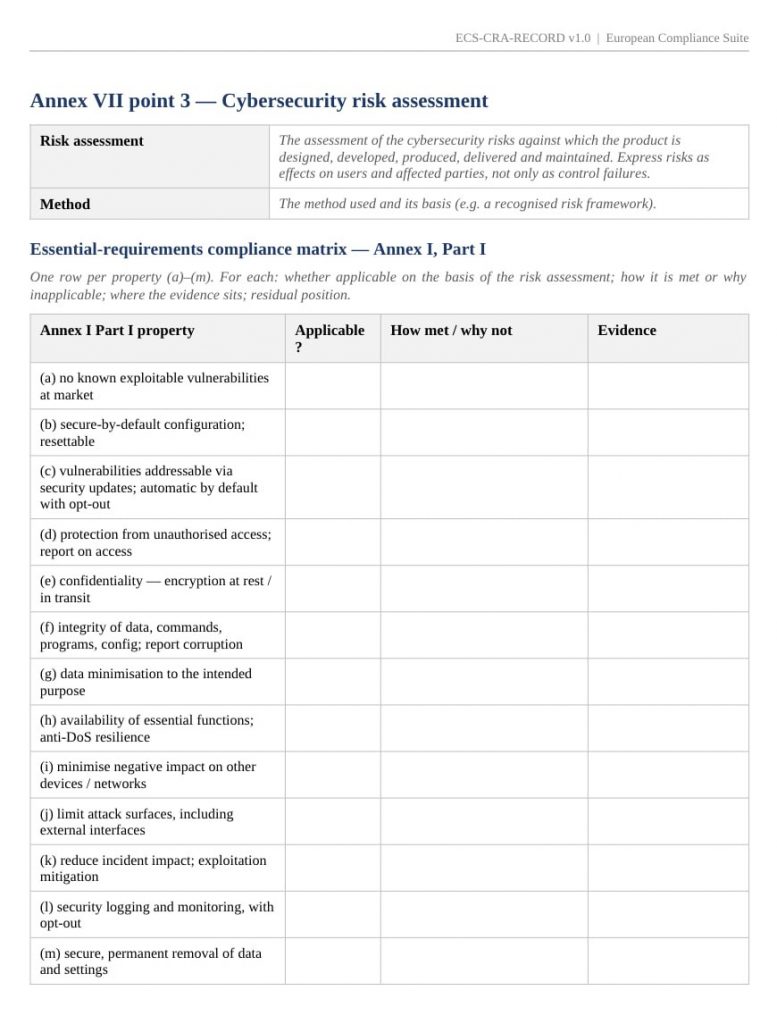
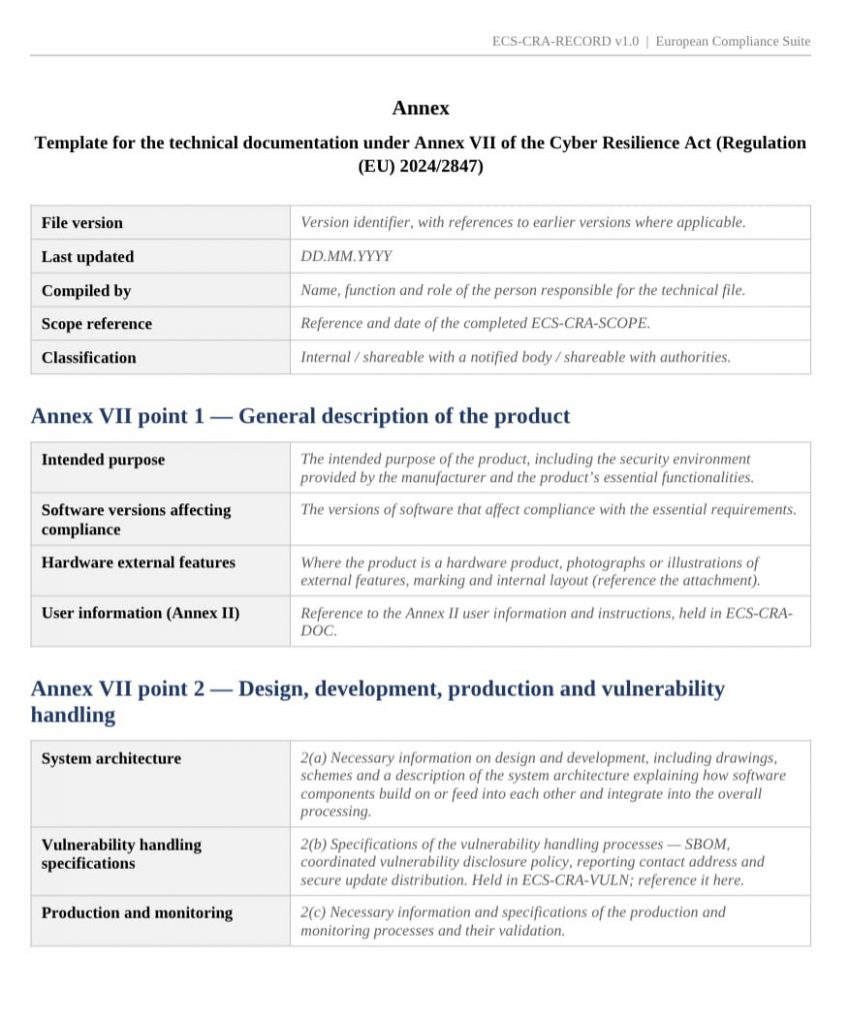
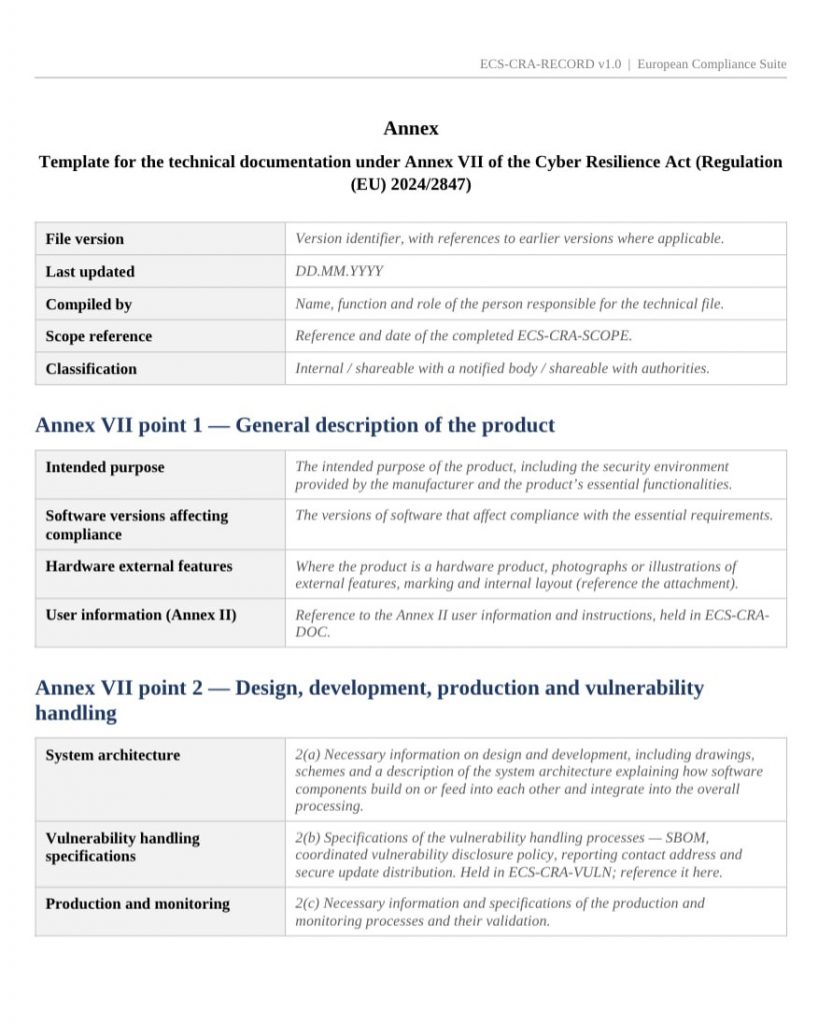
RECORD — the Annex VII technical documentation file, the ten-year technical file, with a compliance matrix covering all thirteen essential security requirements in Annex I Part I, mapped requirement by requirement to your evidence.
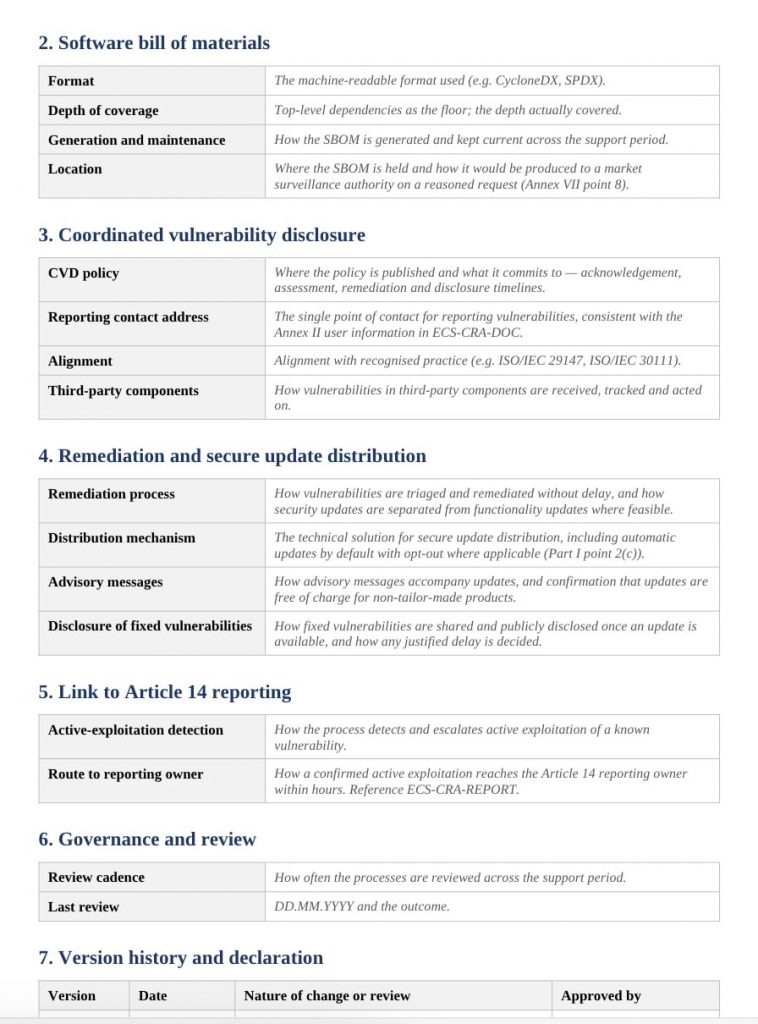
VULN — vulnerability handling and SBOM (Annex I Part II). The eight process obligations, the software bill of materials in machine-readable format (CycloneDX or SPDX), and the coordinated vulnerability disclosure policy.
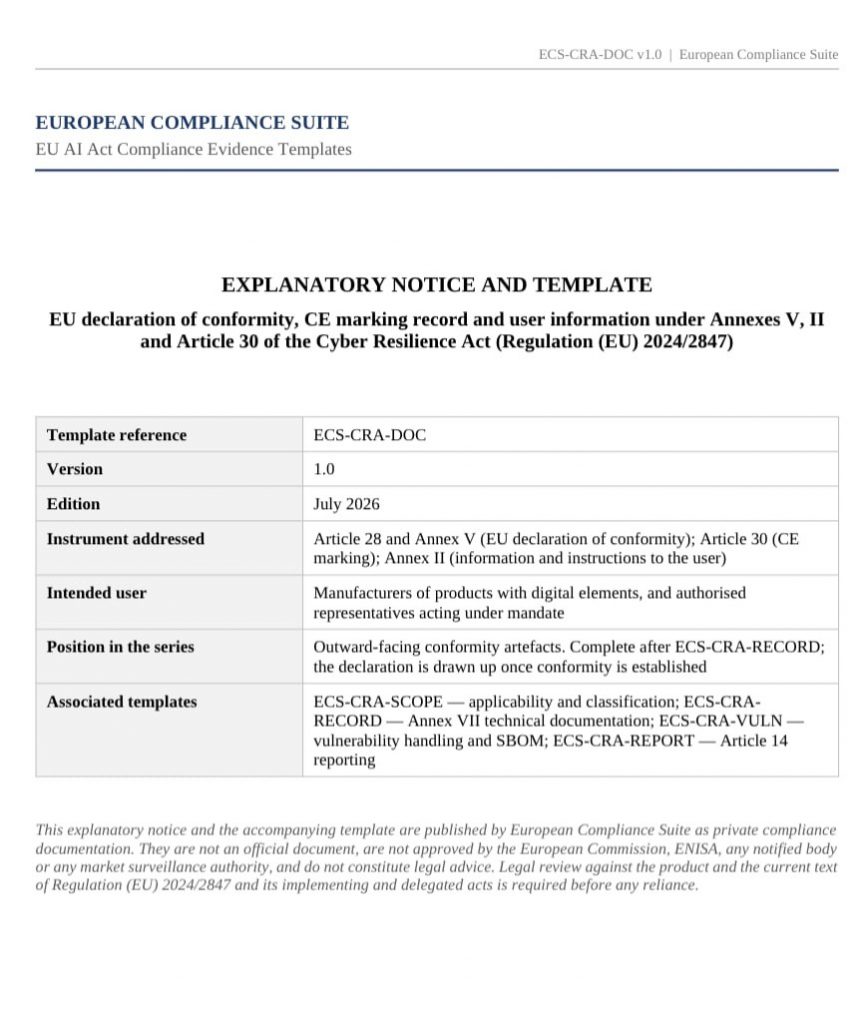
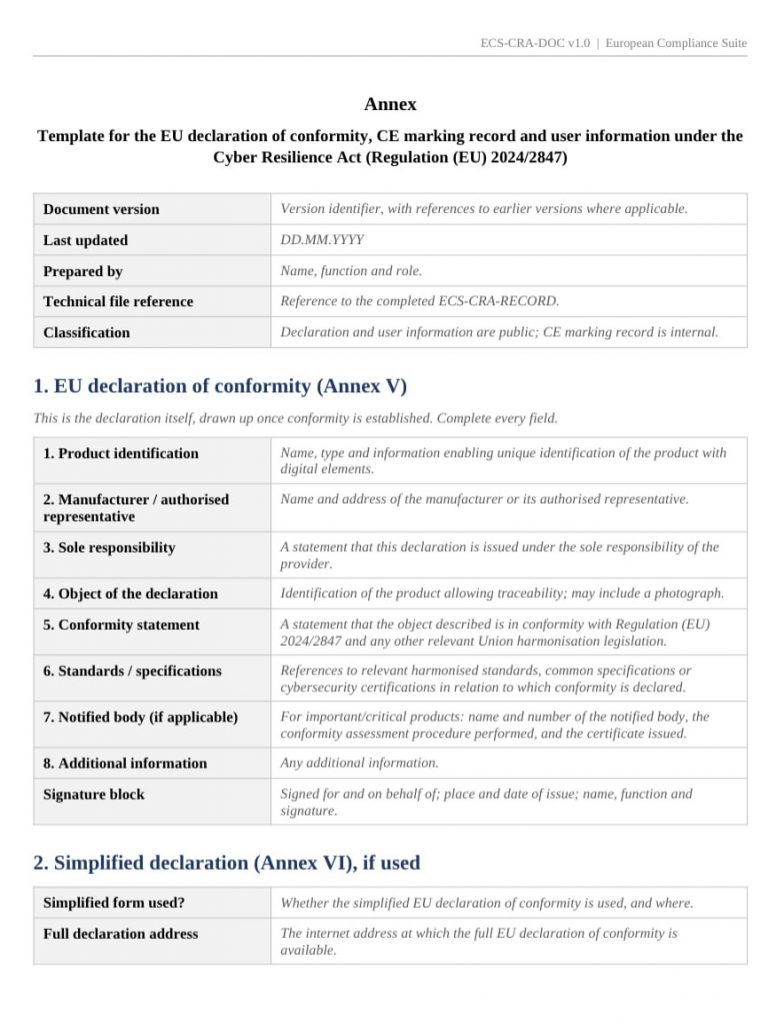
DOC — the EU Declaration of Conformity (Annex V), the CE marking record (Article 30), and the Annex II information you must give users.
Each document is a draft for legal review, structured so a lawyer can approve it fast and a market surveillance authority — or a notified body — can follow it.
Why this maps to the Regulation, not to a generic checklist
CRA compliance is defined precisely in the annexes, and this pack is built to them.
- Annex VII fixes the eight-point content of your technical file
- Annex I Part I lists the thirteen security properties your product must have. Part II lists the eight vulnerability-handling processes you must run.
- Annex V fixes the Declaration of Conformity
- Annex II the user information
- Annexes III and IV the product classifications that decide whether you self-assess or need a notified body.
Every document here is drafted to a specific annex, with the relevant legal text quoted in each so you can see exactly what’s being satisfied.
CRA deadline is already moving
The reporting obligation applies from 11 September 2026 — fifteen months before the essential requirements, conformity assessment and CE marking apply on 11 December 2027.
Meeting a 24-hour reporting deadline becomes a detection-to-disclosure workflow that has to be designed and rehearsed before an incident, not figured out during one. The REPORT document builds that readiness. It’s the reason this pack earns its place on your desk in 2026, not 2027.
Specifically built to help you fulfil your vulnerability reporting obligations, get our CRA Vulnerability Reporting Pack.
Start with the free document
Download the SCOPE applicability and classification assessment at no cost. Work through it, and you’ll know whether the CRA applies to your product, how it’s classified, which conformity route you face, and which of the five documents you need — before you spend anything.
Download the free scoping document
Who built this pack
Drafted by a qualified lawyer working in EU AI regulation, not assembled from a template library. Commissioning the equivalent from a law firm is 15 to 40 hours of specialist time. At current rates, that is €6,000 to €18,000.
What the price covers
The full Cyber Resilience Act compliance pack — all five documents — is €700, including twelve months of updates as the harmonised standards and Commission guidance land (€300/year thereafter).
The first CRA harmonised standards are expected across 2026–2027 so updates keep your file current as they arrive. Add a lawyer review of your completed documents, or step up to a full product assessment, when you need it.
A specialist firm scoping a CRA technical file and vulnerability-handling programme from scratch will typically run €6,000–18,000 per product line. The pack is the same structure at a fraction of the cost, with the reasoning included so you understand what you’re signing.
What this pack is not (Important)
This is not legal advice, and it’s not filing-ready out of the box. It’s professionally structured evidence documentation that a qualified lawyer and your product-security team should review against your specific product before you rely on it. It takes positions on genuinely unsettled questions — borderline product classification, the open-source-steward carve-out, the support-period floor, and the standards-availability test that decides whether an “important” product needs a notified body — that you will want to review as guidance and harmonised standards mature.
FAQ
When does the Cyber Resilience Act apply?
The Cyber Resilience Act, Regulation (EU) 2024/2847, applies in stages. The reporting obligations in Article 14 apply from 11 September 2026, requiring manufacturers to report actively exploited vulnerabilities and severe incidents. The main obligations, including the essential cybersecurity requirements, conformity assessment and CE marking, apply from 11 December 2027. Notified body provisions applied earlier, from 11 June 2026.
What is the CRA 24-hour reporting requirement?
From 11 September 2026, a manufacturer that becomes aware of an actively exploited vulnerability in its product must submit an early warning within 24 hours. A fuller notification follows within 72 hours, and a final report within 14 days. Severe incidents affecting the security of the product follow the same 24-hour and 72-hour sequence, with a final report within one month. Reports go through the single reporting platform to the CSIRT designated as coordinator and to ENISA.
What triggers the 24-hour clock?
Awareness of active exploitation, not a confirmed breach or customer harm. The obligation does not wait for an incident, a compromise, or a report from a customer. If a manufacturer becomes aware that a vulnerability in its product is being exploited, the clock starts — including where that awareness comes from a support ticket, a researcher, or a public disclosure. Because the clock starts on awareness, manufacturers need to be able to evidence when awareness occurred.
Which products does the Cyber Resilience Act cover?
The CRA covers products with digital elements, meaning any software or hardware product and its remote data processing solutions that can be connected directly or indirectly to a device or network. This reaches most commercial software, including SaaS delivered with remote data processing, embedded firmware, operating systems, connected consumer devices and industrial equipment. Products already regulated under sector-specific EU cybersecurity law, such as medical devices and motor vehicles, are excluded.
Does the CRA apply to software with no AI in it?
Yes. The Cyber Resilience Act is not an AI regulation, and it applies regardless of whether a product contains AI. A conventional SaaS platform, a mobile app with a backend, or an embedded controller falls within scope on the same terms as an AI product. This is why CRA reaches a much wider population of companies than the EU AI Act does.
What are the CRA product categories?
Products are divided into default products, important products in Class I and Class II, and critical products. Default products, which are the large majority, are self-assessed. Important products face stricter conformity routes, and Class II generally requires a third-party assessment or application of a harmonised standard. Critical products require European cybersecurity certification. Classification determines the conformity route and therefore the cost, which is why it is the first thing to establish.
Does the CRA apply retroactively to products already on the market?
Broadly no. Products placed on the EU market before 11 December 2027 are not subject to the main obligations unless they are substantially modified after that date. The reporting obligations from 11 September 2026 attach to products the manufacturer is placing on the market from that point, together with the ongoing support obligations for them. This is a forward-looking regime rather than a sweep of the installed base.
What is a CRA support period?
The support period is the time during which a manufacturer must provide security updates, and it should reflect the expected product lifetime, with a minimum of five years unless the product is expected to be in use for less. The support period must be communicated to the buyer before purchase. That disclosure now overlaps with the Empowering Consumers Directive’s pre-contractual information requirements for goods with digital elements, which apply from 27 September 2026.
Does the CRA require an SBOM?
Yes, in substance. Manufacturers must identify and document the components contained in the product, covering at least the top-level dependencies, in a commonly used machine-readable format. The software bill of materials supports the vulnerability handling obligations, because a manufacturer cannot assess whether an upstream vulnerability affects its product without knowing what the product contains.
What are the CRA vulnerability handling requirements?
Manufacturers must identify and document vulnerabilities and components, remediate vulnerabilities without delay including through security updates, apply regular effectiveness testing, publicly disclose fixed vulnerabilities with information about their impact, put a coordinated vulnerability disclosure policy in place, provide a contact address for reporting, and distribute updates securely and free of charge.
Does the Cyber Resilience Act apply to non-EU companies?
Yes. The CRA applies to products with digital elements made available on the EU market, regardless of where the manufacturer is established. A non-EU manufacturer without an EU establishment must appoint an authorised representative in the Union, and the importer and distributor carry their own verification duties before placing the product on the market.
What are the penalties under the CRA?
Non-compliance with the essential cybersecurity requirements or the manufacturer obligations can attract fines of up to €15 million or 2.5% of worldwide annual turnover, whichever is higher. Breaches of other obligations carry lower ceilings, and supplying incorrect, incomplete or misleading information to notified bodies or market surveillance authorities carries its own tier.
How does the CRA relate to NIS2?
They regulate different things. NIS2 imposes cybersecurity risk management and incident reporting duties on essential and important entities as organisations. The CRA imposes security requirements on products placed on the market. A company can be an important entity under NIS2 and a manufacturer under the CRA simultaneously, with two separate reporting obligations running on different clocks to different recipients.
How does the CRA relate to the EU AI Act?
Where a high-risk AI system also falls within the CRA, meeting the CRA’s essential cybersecurity requirements is deemed to satisfy the AI Act’s cybersecurity requirements under Article 15, subject to the conditions in Article 12 of the CRA. This is one assessment serving two regimes, but only for the cybersecurity limb — it does nothing for accuracy, robustness, data governance or documentation.
What is in the CRA Documentation Pack?
A scope and classification assessment establishing whether the product is in scope and which category applies; a software bill of materials structure and component inventory; a vulnerability handling procedure; a coordinated vulnerability disclosure policy; a 24-hour and 72-hour reporting standard operating procedure with named decision-makers; ENISA and CSIRT intake preparation; technical documentation structure; support period determination and disclosure; and an EU declaration of conformity template.
Do I need a notified body for CRA compliance?
Most manufacturers do not. Default products, which are the majority, use internal control and self-assessment. A notified body is required for certain important Class II products where harmonised standards have not been applied in full, and critical products require European cybersecurity certification. Establishing your product category early determines whether you need to budget for third-party assessment at all.
Does the CRA apply to my company if we are based outside the EU?
Yes. The CRA applies extraterritorially — any manufacturer placing a product with digital elements on the EU market faces the same obligations regardless of where the company is established. UK, US, Canadian, Swiss, and Indian manufacturers with EU users or EU enterprise clients are in scope on the same terms as EU-established manufacturers. Non-EU manufacturers must also satisfy importer and distributor chain requirements and may need an EU-established authorised representative depending on the applicable regulation.
What is the 24-hour ENISA reporting deadline and does it apply to me now?
From 11 September 2026, manufacturers must submit an early warning to ENISA’s Single Reporting Platform within 24 hours of becoming aware of an actively exploited vulnerability or a severe incident affecting their product. This is followed by a vulnerability notification within 72 hours and a final report within 14 days. Critically, this obligation reaches products already on the market — you do not need to have placed a new product after the deadline for the reporting obligation to apply. If your product has EU users on 11 September 2026, you must be able to meet the 24-hour timeline from that date.
What is a product with digital elements under the CRA?
A product with digital elements is any hardware or software product that connects — directly or indirectly — to another device or network. The definition is intentionally broad. Connected hardware, standalone software applications, mobile apps, cloud-delivered services, APIs, and AI systems delivered over a network all fall within it. Products that are exclusively customised services or purely cloud services without a software component may fall outside scope, but the boundary requires case-by-case assessment.
What is the difference between CRA default, Class I, and Class II products?
The CRA classifies products into three tiers based on cybersecurity risk. Default category products — the majority — can self-assess against the essential requirements and issue their own EU declaration of conformity.
Class I important products present higher cybersecurity risk and must either self-assess against a harmonised standard or use a notified body where no harmonised standard applies.
Class II important products present the highest risk and require mandatory third-party conformity assessment — self-assessment is not available. The classification determines your conformity assessment pathway and the level of regulatory scrutiny your product faces.
What does the CRA Documentation Pack include?
The pack contains five documents structured around the CRA’s own document architecture. SCOPE establishes whether your product is in scope, its classification tier, and its conformity assessment route.
REPORT covers Article 14 incident and vulnerability reporting — the 24-hour, 72-hour, and 14-day cadence to ENISA with the internal escalation chain that makes the 24-hour deadline achievable.
RECORD is the Annex VII technical documentation file with a compliance matrix covering all thirteen essential security requirements in Annex I Part I.
VULN covers vulnerability handling and SBOM obligations under Annex I Part II, including the coordinated vulnerability disclosure policy and software bill of materials in CycloneDX or SPDX format.
DOC is the EU Declaration of Conformity under Annex V, the CE marking record, and the Annex II user information requirements.
Every document is structured for legal review and formatted so a market surveillance authority or notified body can follow it.
What is a software bill of materials and is it required under the CRA?
A software bill of materials is a machine-readable inventory of every component in a software product — libraries, dependencies, open source packages, and their versions. The CRA requires manufacturers to identify and document components under Annex I Part II vulnerability handling obligations. The SBOM must be in a machine-readable format — CycloneDX or SPDX are the accepted standards. It is the foundation of your vulnerability management process: you cannot monitor, patch, or disclose vulnerabilities in components you have not inventoried.
Does the CRA apply to open source software?
Partially it does. Open source software supplied in the course of a commercial activity is in scope — where the manufacturer derives commercial benefit, the CRA applies. Genuinely non-commercial open source software benefits from a specific exemption. The boundary between commercial and non-commercial is not always clear, particularly for AI models released under permissive licences but supported by commercial entities. The SCOPE document in the pack establishes whether your specific software sits inside or outside the exemption.
How does the CRA interact with the EU AI Act for AI software products?
Both regulations frequently apply to the same AI software product simultaneously. The EU AI Act governs the AI system itself — risk classification, technical documentation, transparency, and human oversight. The CRA governs the product’s security — vulnerability handling, secure design, and incident reporting. They overlap in technical robustness and post-market monitoring but impose distinct obligations in other areas. Satisfying one does not satisfy the other.
The CRA Documentation Pack covers CRA obligations only. Where your product is also subject to EU AI Act requirements, the EU AI Act Product Assessment is the relevant engagement.
What are the penalties for CRA non-compliance?
Non-compliance with the essential cybersecurity requirements carries fines of up to €15 million or 2.5% of global annual turnover, whichever is higher. Non-compliance with other CRA obligations — including vulnerability reporting and documentation requirements — carries fines of up to €10 million or 2% of global annual turnover. Providing incorrect or misleading information to market surveillance authorities carries fines of up to €5 million or 1% of global annual turnover. Market surveillance authorities can also require product withdrawal.
The 11 September 2026 reporting deadline is the first point at which enforcement becomes directly applicable to products already on the market.