
Digital Operational Resilience Act Templates
DORA ICT Third-Party Provider Pack
This DORA Template pack is built for technology companies — SaaS, cloud, infrastructure, data services — that supply EU financial entities and keep getting pulled into their DORA obligations. Six documents, written entirely from your side of the relationship.
If you sell technology to a bank, insurer or investment firm in the EU, the Digital Operational Resilience Act reaches you through your customer. They must carry you in their Register of Information in a prescribed format, your contract with them must contain the Articles 28–30 terms.
And if your service is significant enough, they’ll expect you to handle incident notifications and penetration testing on their timetable. Most suppliers discover all of this the day a customer’s compliance team sends the questionnaire. This pack gets you ahead of it.
Why the supplier side is different
Every DORA template on the market is written for the financial entity. This one is written for the supplier. The obligations that land on you are a specific, narrow slice of DORA — being carried in the register, carrying the right contract terms, disclosing your chain, notifying incidents on your customer’s clock — and reading them out of an entity-facing guide means wading through hundreds of pages of obligations that aren’t yours.
This DORA template pack covers exactly your slice, from your point of view, so you can answer the questionnaire with a folder rather than a scramble.
What you get:
This DORA template pack contains six documents, each an explanatory notice (what the obligation is and why it reaches you) paired with a ready-to-complete template:
- Criticality Self-Assessment — where you stand against the Article 31 designation criteria, the Article 31(8) carve-outs, and the twelve-month EU-subsidiary requirement for third-country providers. Start here; it tells you what the rest of the pack must cover. Free to download — see below.
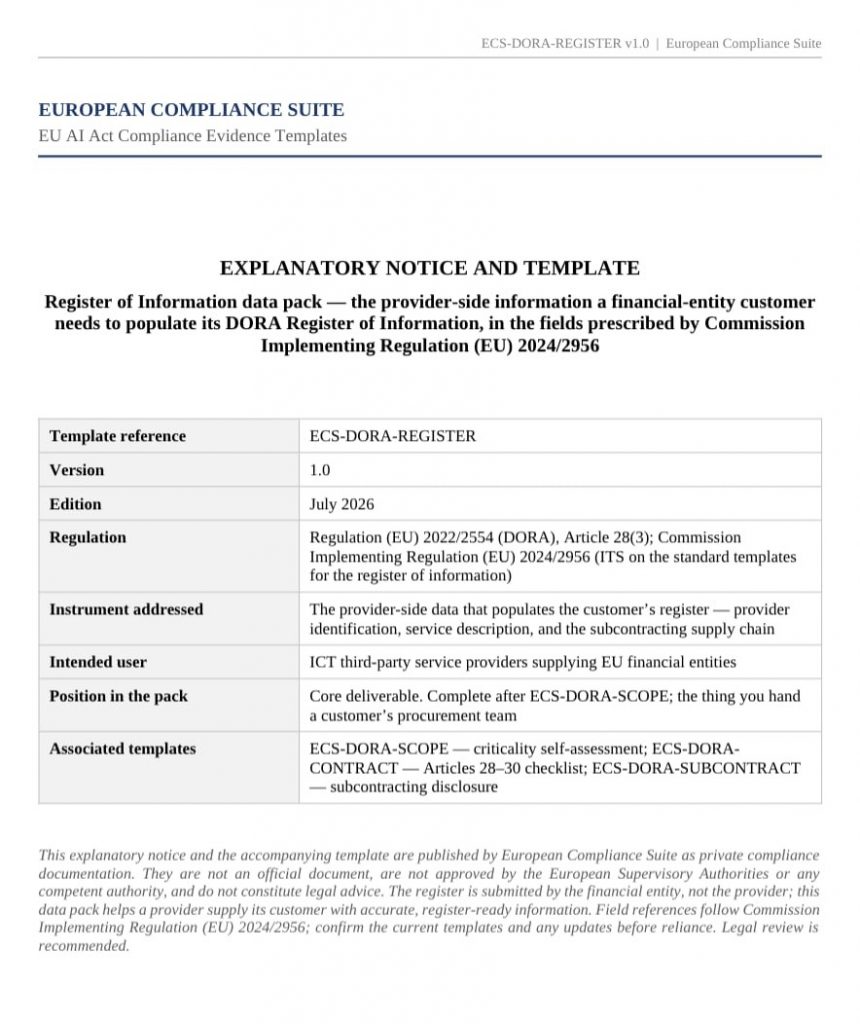
- Register of Information Data Pack — the provider-side fields your customer needs to populate its register, in the prescribed ITS format: your identification and LEI, the contract inputs, the service classification, and the subcontracting chain. Hand this over instead of filling in each customer’s spreadsheet from scratch.
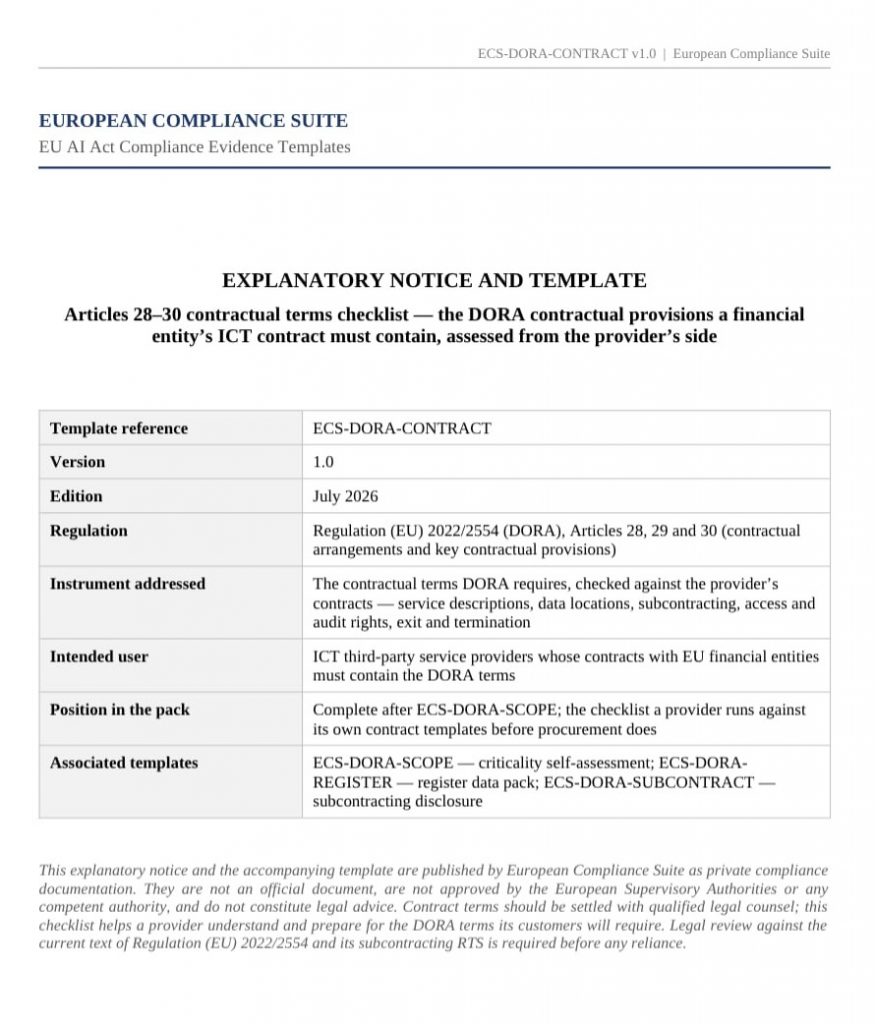
- Articles 28–30 Contractual Terms Checklist — the DORA clauses your contract must contain, in two tiers (baseline, and the heavier set for critical or important functions), with the access, audit and exit-strategy pinch points flagged.
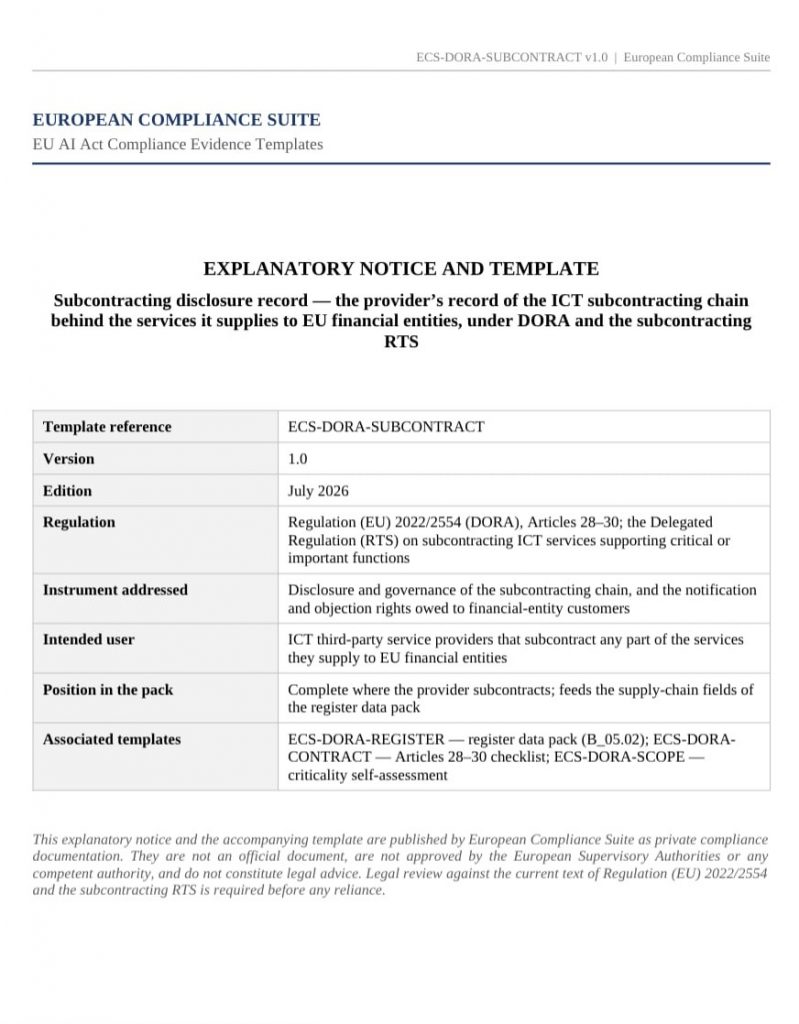
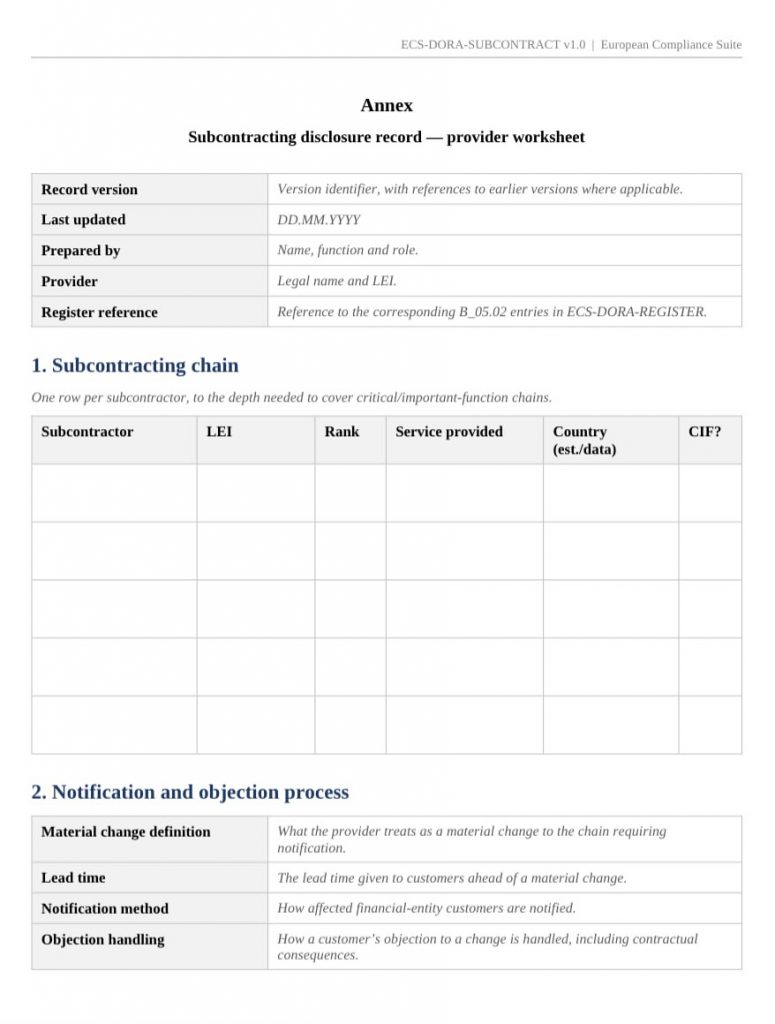
- Subcontracting Disclosure Record — the chain behind your service, the material-change notification process, and your customer’s right to object — the single most under-populated part of every register.
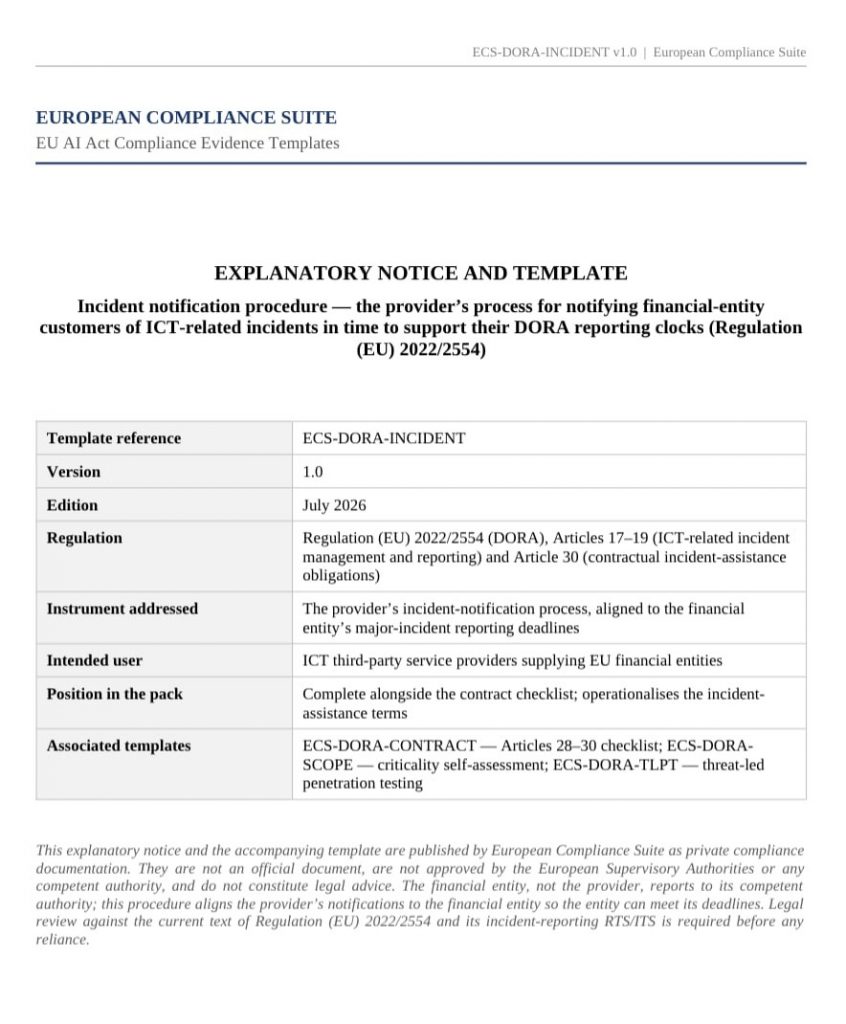
- Incident Notification Procedure — aligned to your customer’s DORA reporting clocks, so when your service has an incident, your customer can still meet its deadline.
- Threat-Led Penetration Testing Participation Record — how you take part when a customer’s TLPT includes your systems, with multi-tenant safeguards and pooled-testing arrangements.
Who needs these DORA ICT templates
- SaaS, cloud, infrastructure and data-services companies that supply EU banks, insurers, investment firms or other financial entities.
- Vendors whose sales cycle keeps stalling on a DORA addendum or a register questionnaire.
- Third-country (non-EU) providers who need to understand the subsidiary question before it’s urgent.
- Providers who support what their customers call a “critical or important function” and are being pulled into audit rights and penetration testing.
- The person at a supplier who owns “our customers’ compliance questionnaires” and wants to stop answering them from a blank page.
One thing this pack makes clear, so you don’t get it wrong
Being designated a critical ICT third-party provider is a determination the European Supervisory Authorities make, not something you declare, and not something that happens to most suppliers.
As of the first official list, only nineteen providers were designated, all hyperscale cloud and core-platform businesses.
For almost every supplier, the valuable output of the self-assessment is a documented, defensible conclusion that you are not critical — together with a clear view of the ordinary register and contract obligations that do apply to you. The pack is built to give you both.
Start with the self-assessment
Download the Criticality Self-Assessment free. Work through it and you’ll know your real exposure, whether designation is even a question for you, and which of the other documents you need before your next customer’s procurement cycle.
Download the free assessment document
What the DORA template price covers
€700 includes twelve months of updates as the DORA delegated and implementing acts and ESA guidance develop.
A law firm assembling this from scratch — criticality analysis, register data, the Articles 28–30 clause review, subcontracting and incident procedures — will typically run €6,000–15,000. The pack is the same readiness at a fraction of the cost, and it turns a recurring procurement scramble into a folder you hand over.
Know someone who’d benefit from this?
Refer a colleague and earn 20% commission on template pack and documentation purchases. Join our referral or learn more about the affiliate program.
What this pack is not (Important)
This DORA template pack is not legal advice, and it’s not a designation or a certification. The criticality self-assessment helps you understand your position under Article 31 — it does not designate you, and only the European Supervisory Authorities can. The contract checklist helps you prepare for the Articles 28–30 terms, but the terms themselves should be settled with counsel.
Every document is a draft to be reviewed against your circumstances and the current text of DORA and its delegated acts before you rely on it.
FAQ
What does DORA stand for and what does it regulate?
DORA stands for Digital Operational Resilience Act. It regulates how financial entities and their ICT suppliers manage technology risk, respond to incidents, test resilience, and oversee third-party dependencies. It is not a cybersecurity certification framework — it is a binding EU regulation with direct enforcement consequences for financial entities and contractual consequences for the ICT companies that supply them.
When did DORA come into force?
17 January 2025. All obligations applied from that date — there was no phased implementation for financial entities. ICT third-party providers became subject to their customers’ contractual oversight obligations from the same date.
Is DORA the same as NIS2?
No. NIS2 is a broad cybersecurity directive applying across critical sectors. DORA is lex specialis for the financial sector — where both apply to the same obligation, DORA takes precedence. A financial entity that satisfies DORA’s ICT risk management and incident reporting requirements satisfies the equivalent NIS2 obligations. For ICT suppliers to financial entities, DORA is the primary framework to address.
What is an ICT third-party provider under DORA?
Any undertaking providing digital and data services to a financial entity on an ongoing basis — including cloud computing, software, data analytics, data centres, and any ICT infrastructure service. The definition is broad. Most SaaS, API, and platform businesses supplying EU banks, insurers, or investment firms qualify regardless of whether they consider themselves technology companies or not.
What is a critical or important function under DORA?
A function whose disruption would materially impair a financial entity’s financial performance, operational continuity, or regulatory compliance. Financial entities classify their ICT dependencies against this threshold — suppliers supporting critical or important functions face heavier contractual obligations including more granular audit rights, sub-outsourcing controls, and business continuity requirements. The classification is the financial entity’s determination, not the supplier’s, but it has direct consequences for what your contract must contain.
What is the Register of Information under DORA?
A mandatory record maintained by every financial entity listing all contractual arrangements with ICT third-party providers. The European Supervisory Authorities have prescribed the format through Implementing Technical Standards — specific fields including provider identification, LEI, service classification, contract details, and subcontracting chain. Financial entities submit their Register of Information to regulators on request. ICT suppliers are regularly asked to provide the provider-side data fields their customers need to populate it.
What is an LEI and do ICT suppliers need one for DORA?
A Legal Entity Identifier is a 20-character alphanumeric code that uniquely identifies a legal entity in financial transactions. The DORA Register of Information ITS requires LEIs for ICT third-party providers where one exists.
If your company does not have an LEI and your customers are asking for one to populate their register, you will need to obtain one — they are issued by accredited Local Operating Units and typically cost €65–€130 per year to register and maintain.
What is the DORA subcontracting disclosure obligation?
ICT third-party providers must disclose the chain of subcontractors behind their service to their financial entity customers, particularly where a subcontractor supports a critical or important function. Material changes to the subcontracting chain — adding, replacing, or removing a material subcontractor — must be notified before the change takes effect, giving the customer the right to object.
Most ICT suppliers have not mapped their subcontracting chain at the level of detail DORA requires and have not established a change notification process.
What are DORA’s incident notification requirements for ICT suppliers?
DORA sets reporting timelines for financial entities — four hours for initial notification of a major incident, 72 hours for an intermediate report, one month for a final report. ICT suppliers must notify their financial entity customers of incidents affecting their service within timeframes that allow the customer to meet these regulatory deadlines. The specific notification timelines must be written into the contract under Article 30. A supplier whose incident notification process cannot support a customer’s four-hour regulatory clock creates a contractual and regulatory problem for that customer.
What is Threat-Led Penetration Testing under DORA?
A structured, intelligence-led security test that significant financial entities must conduct every three years. Where an ICT supplier’s systems are in scope — because they support a critical or important function — the supplier must participate. Participation requires controlled system access, multi-tenant safeguards where the same infrastructure serves multiple financial entity customers, and documentation of the testing process. Pooled testing arrangements — where multiple financial entities test the same supplier together — are permitted and increasingly common for widely-used platforms.
What is the critical ICT third-party provider designation under DORA?
A formal designation made by the European Supervisory Authorities — EBA, ESMA, and EIOPA — based on systemic importance to the EU financial sector. Designated providers face direct supervisory oversight including information requests, on-site inspections, and binding recommendations. As of the first official list, only nineteen providers were designated, all hyperscale cloud and core-platform businesses. For most ICT suppliers, the relevant output of a designation assessment is a documented conclusion of non-criticality — which is itself a compliance record worth maintaining.
What is the twelve-month EU-subsidiary requirement under DORA?
Where a third-country ICT provider is designated critical by the ESAs, it must establish a subsidiary inside the EU within twelve months of designation. This requirement applies only to designated critical providers — not to ICT suppliers generally. Third-country providers with a growing EU financial sector customer base should assess their designation risk annually, as systemic importance can increase as EU adoption grows.
What DORA contract clauses must ICT suppliers include?
Article 30 mandates specific provisions in all ICT third-party contracts with financial entities — service description, service level requirements, data location, security standards, incident notification timelines, audit and access rights, and exit provisions. A heavier set of provisions applies where the service supports a critical or important function. Pre-2025 contracts that do not include these provisions are non-compliant. Financial entities are required to remediate non-compliant contracts and are doing so across their supplier base.
Can one DORA contract clause set cover all EU financial entity customers?
In principle, yes — the Article 30 mandatory provisions are standardised. In practice, different customers apply different interpretations of what constitutes a critical or important function, have different audit right requirements, and may insist on customer-specific addenda. A baseline-compliant contract that includes all mandatory provisions reduces negotiation friction and gives customers less to push back on, but it will not eliminate customer-specific requests entirely.
How does DORA affect AI companies supplying financial services?
AI systems used by financial entities for credit scoring, fraud detection, trading, risk assessment, or customer-facing functions are ICT services within DORA’s scope. The AI supplier is an ICT third-party provider subject to the same register, contract, subcontracting, incident notification, and penetration testing obligations as any other technology supplier. Where the AI system also falls under EU AI Act high-risk obligations, both frameworks apply simultaneously — DORA governs the operational resilience of the service, the EU AI Act governs the system’s classification, documentation, and conformity assessment.